

Dear Kathy,
I have saved old texts between me and my mom to remind me of how our arguments go. She gets really upset and “flames” me. She claims to just be sharing her feelings, but she doesn’t realize that “sharing your feelings” does not include things like calling me a “selfish brat.”
When I think about reconciling with my mom, it’s after a period of time with no contact with her flaming part. I feel more loving and less mad; it’s almost like I forget what happened. To make sure I am remembering correctly, I review our old text thread. Whoosh—it all comes back to me. Suddenly, I don’t want to reconcile anymore.
I think if I want to give her a second chance, I need to delete the texts. But then, I won’t have any record and we might just go to that dark place again. What do you recommend?
— Loving, Hurt, Missing, and VERY Cautious
Dear Loving, Hurt, and Cautious,
Before texting, people saved letters from loved ones—for good and for ill. While sending a text provides what feels like immediate relief for powerful feelings, that relief is often fleeting. Sending a heated message doesn’t actually offload the weight of the emotion in a meaningful way. Once the screen goes dark, the feelings linger, the conflict remains, and the wound is now inflamed on both sides.
When you re-read those old texts, you aren’t just remembering them; you are re-inflaming yourself. You are reviving the heat of the anger at a time when you need clarity most.
We Used to Write Letters
When I think about letters that were saved, those letters were at least written by hand—a slower process. They were possibly edited and required a stamp, an envelope, and a walk to the mailbox. All of these steps take time and give space for the writer to think about the impact of their words. Today, we have “Draft” folders where we can place our “hot” emails, but when you are fired up and have access to texting, you have a flamethrower at the ready, and the urge to use it is powerful.
The Science of Recalling
In last week’s column, I described what happens when memory is retrieved. Memory is a reconstruction; we don’t “play back” a tape. Instead, we rebuild the event from fragments of memory every time we recall it.
The amygdala (the brain’s fire alarm) acts like a highlighter. If an event causes stress or fear, the brain “burns” it in more deeply. When you look at those texts, your amygdala doesn’t know the argument happened six months ago; it reacts as if the “selfish brat” comment is happening right now. This sends a surge of cortisol through your system, causing emotional dysregulation. It is nearly impossible to be “vulnerable enough” for reconciliation when your brain is screaming at you to put your armor on or run the other direction.
The Fear of Forgetting
What is it you are afraid you will forget? Are you afraid that the return of your loving feelings will erase the reality of the hurt?
In many families, children learn to suppress their anger to maintain closeness. Tactics like the “silent treatment” are often used by a parent to coerce a child into changing their behavior or offering an apology. When you are a child receiving that silence, you usually feel angry at first—but soon, the weight of the loneliness takes over. You just want to be close to your parent again.
To bridge that gap, many children learn to turn their anger inward as shame, eventually convincing themselves to let go of their outrage just to be back in their parent’s graces. If you grew up this way, or something similar occurred, those saved texts represent a tether to your own truth. They offer a guard against the old habit of succumbing to loneliness, feeling shame, and giving up the legitimacy of your anger.
Please hear me: I am not recommending amnesia. I am recommending that you find a way to honor your history without forcing your nervous system to live in the emotional wreckage of it.
Letting the Charge Disperse
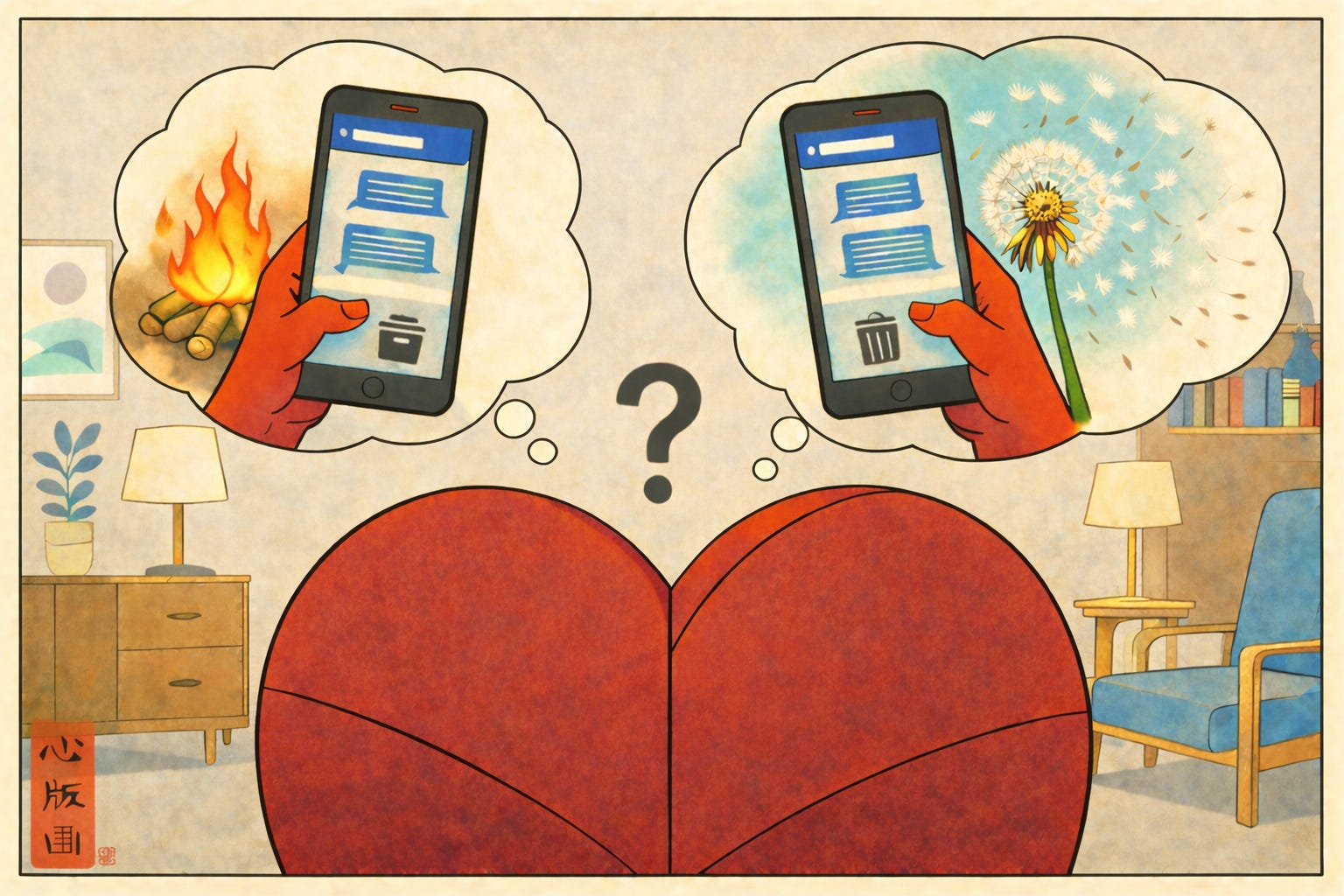
In the drawing, there is an image of a dandelion seed head (sometimes called a “dandelion clock”). The individual seeds blow away in the wind; they are not scattered nearby to grow more weeds. This is the goal: letting the emotional charge scatter.
We want to find a way to store the memory that is respectful of the hurt, but is no longer a hot fire. This allows you to recall the pain when necessary for your safety, but also see a path toward building new understanding.
My Recommendations for Moving Forward
Move the Record: You don’t have to hit “delete” today. Summarize the texts in a journal or move the thread to a password-protected file on your computer. Get the flamethrower out of your pocket.
Befriend Your Anger: Value your anger’s importance; it has been your protector for a long time. Ask it to sit in the passenger seat during your next conversation. Let it serve as a memory bank you can consult rather than the driver of the dialogue. You want to be able to access the "data" of your anger without being hijacked by the "heat" of the emotion.
Snapshot vs. Pattern: Consider if those texts were a snapshot of a particularly uncontained moment, rather than the whole truth of the relationship.
Vulnerability with Boundaries: Give your hurt feelings space to be heard, but ensure you remain emotionally protected enough to stay grounded.
Alert your support network: Tell them that you want and need their support—both to avoid reviewing the texts unnecessarily and to help you plan a healthy meeting.
Respect for yourself, your feelings, and your loved one are the keys to a possible reconciliation. By clearing the “digital inflammation,” you are giving yourself the space needed to see if a healthier reconnection is possible.
_________________________________
Dear Loving, Hurt, and Cautious,
You are navigating challenging terrain in your relationship with your mother, and it takes real courage to do so. I hope she receives your offer to talk with a spirit of openness and a willingness to truly hear you.
The truth is, as humans, we aren’t always as skilled as we need to be to get along well with each other—especially when the going is rough. By choosing to approach this conversation with a regulated heart rather than a re-inflamed one, you are taking a significant and hopefully very useful risk.
Best wishes, and please let me know how it goes!
Kathy
Please contact me at ksinsheimermft@gmail.com or in the Comments section.
This is column #34
Since my column for this week was already in process, I have begun to write on your suggested topic for my column that I will likely "publish: on May 2. Just wanted to give you an update.
Kathy
Thank you Virginia, for your request and Karemm for seconding the request. I will start a column on this very topic.! If others want to add to this request, the topic is , as I understand it,
"What are practical strategies to navigate the early, volatile stages of estrangement?"
And, yes, if others would like to add strategies you have found, please chime in!
Kathy