

Welcome to my first column in a series about estranged relationships. In this space, I’ll be responding to letters from people who are navigating the pain and complexity of family estrangement. The letters and examples shared in this column are composites of real stories and are not intended to represent any specific individual or family.
Today, I take up an important and ever-present question: How can I live with the loss I feel for my loved one who has chosen distance?
Being cut off or feeling we are losing a loving relationship is heartbreaking. Living every day with this loss can be overwhelming. Addressing this loss from the perspective of the parent, sibling, or adult child is one of the first projects of my Dear Estranged column. My first full column is on the topic of parental loss in estrangement.
The helplessness parents feel when their child has gone low or no contact can be debilitating. Even when adult children feel they have been clear about their reasons for seeking distance, parents often experience estrangement as sudden abandonment. The result is a grief that is deep, ongoing, and hard to name.
I start with a letter from a parent:
Dear Kathy,
Six months ago, my adult child informed me they were going “no contact.” Since then, I’ve heard nothing. These months have been some of the most difficult of my life. I can’t sleep. I cry suddenly, wherever I am. I feel foggy and clumsy, as though I’m walking through water. I am confused, enraged, helpless, and desperately sad. The silence leaves me with no information about what went wrong. Please tell me what I can expect as time wears on.
—Distraught Mother
Dear Estranged,
You are not alone. The feelings you describe—grief, confusion, helplessness, even anger—are painfully common for parents whose children have gone “no contact.”
From my work with estranged parents, I’ve developed a new model of three phases of grief, because the familiar models of loss don’t fully fit. Elisabeth Kübler-Ross’s stages of grief, though useful, were written with bereavement in mind. The grief of estrangement is different: it is ambiguous, ongoing, and can unsettle a parent’s very identity.
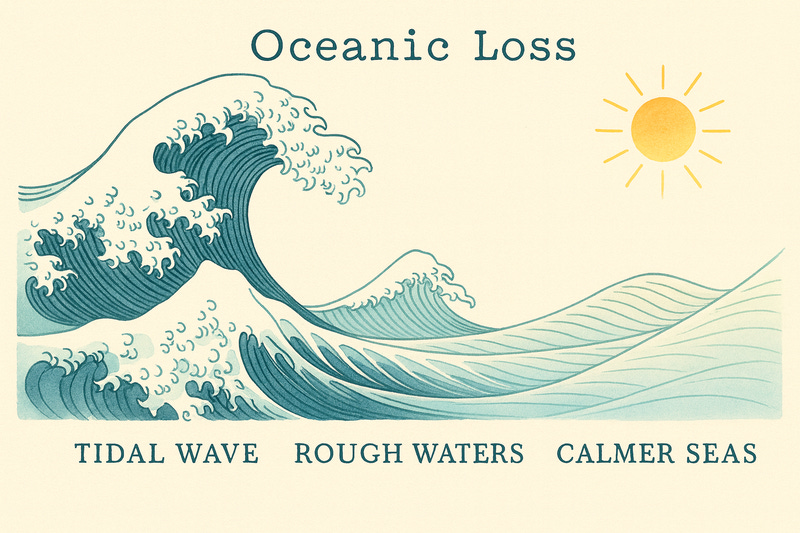
I am calling this model Oceanic Loss: Three Phases of Parental Grief in Estrangement.
Why Estrangement Loss Feels So Different
Estrangement between parents and adult children is increasingly common. Sometimes a child cuts off one parent, then another, and eventually siblings. The impact spreads across the family. Adult children describe needing distance to feel healthier or more whole. Some invite parents into therapy, seeking change and understanding. Sometimes that healing work succeeds. Other times parents resist, or children feel unheard, and contact breaks down.
Unlike the grief of death, there is no funeral, no shared mourning and often no public acknowledgment of the pain. The usual model of grief can fall short because this loss is full of ambiguous emotions—you grieve a person who is still alive, a relationship that is broken but not gone.
Contrary to media portrayals, adult children are not immune to the pain of estrangement. Most feel deep grief too, but often believe they have no other choice. For parents, the sudden silence is bewildering. Many scour memories for clues, sometimes cycling endlessly through self-blame, anger, or denial. Although adult children are clear with me that they have explained their concerns to parents on multiple occasions, parents feel they do not understand why they have been cut off.
In my practice, I see parents accept, adjust, learn and grow but only after the initial shock subsides. What follows are the three phases I’ve observed most often. Like waves, they do not arrive in a neat order and can repeat over time.
6
Oceanic Loss: A Unique Grief
Phase One: Tidal Wave
Shock and Disbelief
This first phase often feels like being hit by a tidal wave. Parents describe shock, disbelief, devastation, and a loss of identity: Who am I, if not a parent in my child’s life?
Feelings in this phase are often confusion, denial and a deep-seated ache. You may feel rejected, lonely and heartbroken, waiting desperately for any word from your child. You know your child could contact you at any time on a variety of platforms, so you are on constant alert. Some parents feel ashamed, don’t share this new development with their friends, and become more isolated. Parents feel overwhelmed and preoccupied by their loss. Each moment can hurt and leave the parent feeling disoriented in their daily life.
My client Susan illustrates this. She and her daughter Lyra had been close, taking “girls’ trips” well into Lyra’s adulthood. A few conflicts arose around Lyra’s wedding, but Susan believed they had worked through them. Then came silence. Susan told no one at first, ashamed and bewildered. She cried daily, replayed old conversations, and felt furious and broken.
Together, Susan and I worked on grounding activities—telling a few trusted friends, joining a support group, and practicing small acts of self-care. At this stage, she wasn’t ready to consider acceptance. What she needed most was reassurance that her tidal wave of feelings was a normal human response to a profound rupture.
Phase Two: Rough Waters
Deepening, Despairing, Adjusting
In time, many parents enter a turbulent but less acute phase. The pain is still raw, but no longer constant. It may lessen for a while, sometimes returning in waves of despair and deep loneliness. They begin to realize estrangement may continue for a longer time than they had hoped. Holidays and milestones remain excruciating, but everyday life can sometimes be managed.
Joe and Nancy came to me during this phase. Newly retired, they had planned to relocate near their child and future grandchildren. Instead, they were told not to move to their child’s city. Nancy wept in session; Joe was more silent, holding his grief inside. Together, they began to work through their grief, enabling them to reimagine their retirement: new plans, new routines, a tentative new beginning. Their ache didn’t vanish, but they began adjusting to a new reality.
In this phase, parents often begin what grief expert David Kessler calls finding meaning. It may be faint at first—an insight, a lesson in resilience, or a shift in perspective—but it is the beginning of growth within loss.
Phase Three: Calmer Seas
Acceptance and Moving Forward
This phase arrives when you begin to accept that the estrangement could be ongoing. This later phase is not the same as “closure.” You may feel a hard-won sense of having adjusted to a new reality. The loss is still real, sometimes deeply painful. But there is more integration, more acceptance, and more space for life alongside the grief. You may have begun to understand yourself more in the midst of your suffering. You may have begun to grow and find a path forward, even in the midst of your pain. You are not pretending the pain is gone, but you have accepted that for your own well being you need to move forward.
Diane and Claudia reached this phase after years of strain from their son’s estrangement, which had even threatened their marriage. One wanted to talk openly about the estrangement; the other wanted privacy. Through couples’ therapy, they learned to balance both needs, share openly with some friends, and protect each other’s boundaries. Slowly, they built a more settled life with their other adult child.
They also began to find growth and meaning. Claudia learned communication skills that strengthened not just her marriage but her friendships and work life. Diane practiced respecting boundaries in new ways, deepening trust with those around her. Even without contact with their son, they discovered ways to grow as partners and as people.
Will I Ever Return to Shore?
If you are in the early stages of estrangement, I know this may feel impossible. But over time, parents frequently find their way from the shock of the Tidal Wave, through Rough Waters, and into Calmer Seas. As a reminder, these phases may not occur in order, and may repeat over time. Going through the phases does not erase the loss, but helps transform it into something survivable.
So, Dear Estranged, your question is both wise and brave: What can I expect? Expect pain. Expect confusion. Expect longing. But also expect that over time, the waves will shift. Your grief may not end, but it will change shape. With support, reflection, meaning-making and new understanding, you can find your bearings again. As you come to better understand yourself and your situation, you will strengthen and grow.
This column is a place for your questions and to share your experiences with estrangement. Let this column be a place where your experience—and others’—can be shared and responded to.
Best wishes for your journey,
Kathy
Please send your questions about estrangement to ksinsheimermft@gmail.com
This is column #2
Yes! I am gratefully a mother in Phase 3, but the work to get there was intense. I continue to hope my son heals from his PTSD, even if it doesn't mean reconciliation with me.
Tremendous first entry. I can imagine so very many people finding much needed support and solace through the wisdom you hold from your many years working with estranged family members. Thank you for sharing it with those of us on Substack!