

Dear Kathy,
I am trying to figure out what my family is expressing with their Thanksgiving plans. My two estranged children seem to be planning to have Thanksgiving together. Our daughter, who is not estranged, is going to her in-laws. My husband and I are not sure we will be with any family. We will take Thanksgiving food to my dad the next day.
What are our children trying to express by celebrating together, not with us? Valuing family but not parents? What happened to celebrating with the generations like we used to do? It wasn’t always easy, but family isn’t. Yet it’s family.
Hurt and Lonely at Thanksgiving
Dear Hurt and Lonely,
I think your estranged children are trying to break one set of cycles while simultaneously preserving another—the traditions that you likely taught them. The fact that two of your children are choosing to be together on Thanksgiving may be showing you that they do value the holiday, but they are trying to disrupt what they feel is dysfunctional in the family dynamic.
You didn’t describe the troubles with your children, but from talking with families, I have thoughts about what could be happening beneath the surface.
The Burden of the Inner Voice
Adult children often feel burdened with patterns they find in themselves and are trying to change. You may have felt something like this in your own life—a pattern in your relationship with yourself that makes you uncomfortable, yet is deeply instilled and hard to shake.
A common example is self-talk. Perhaps, internally, you speak harshly to yourself. Your inner voice might be unkind, judgmental, or demanding. You want that to stop, but sometimes you feel unsafe stopping it, as if that cruel voice is the only thing keeping you “good enough.”
Your children likely struggle with a similar internal dynamic. However, they are handling it differently. They may feel that by estranging themselves, they are creating necessary distance between themselves and those uncomfortable inner voices. Being with you might be “triggering” for them—not necessarily because of who you are today, but because of the old responses and patterns it brings up in them.
In our current age of “cut-off,” a Thanksgiving away from you is their attempt to quiet that noise.
Why Tradition Persists
Even in separation, tradition remains powerful.
“A tradition is not a static thing; it is a continuously flowing river that connects the living to the dead, and the present to the past. It gives us an essential sense of where we are, who we are, and where we are going.” — Robert Bellah (Paraphrased)
Traditions provide the structure on which we place our desires for connection. My guess is that you have favorite holiday dishes you make that you learned from your parents. You may have rituals like saying grace, watching football, or playing cards. You continue these because they ground you, even if the memories of your own parents or grandparents include both pleasure and strain.
The “Friendsgiving” Shift
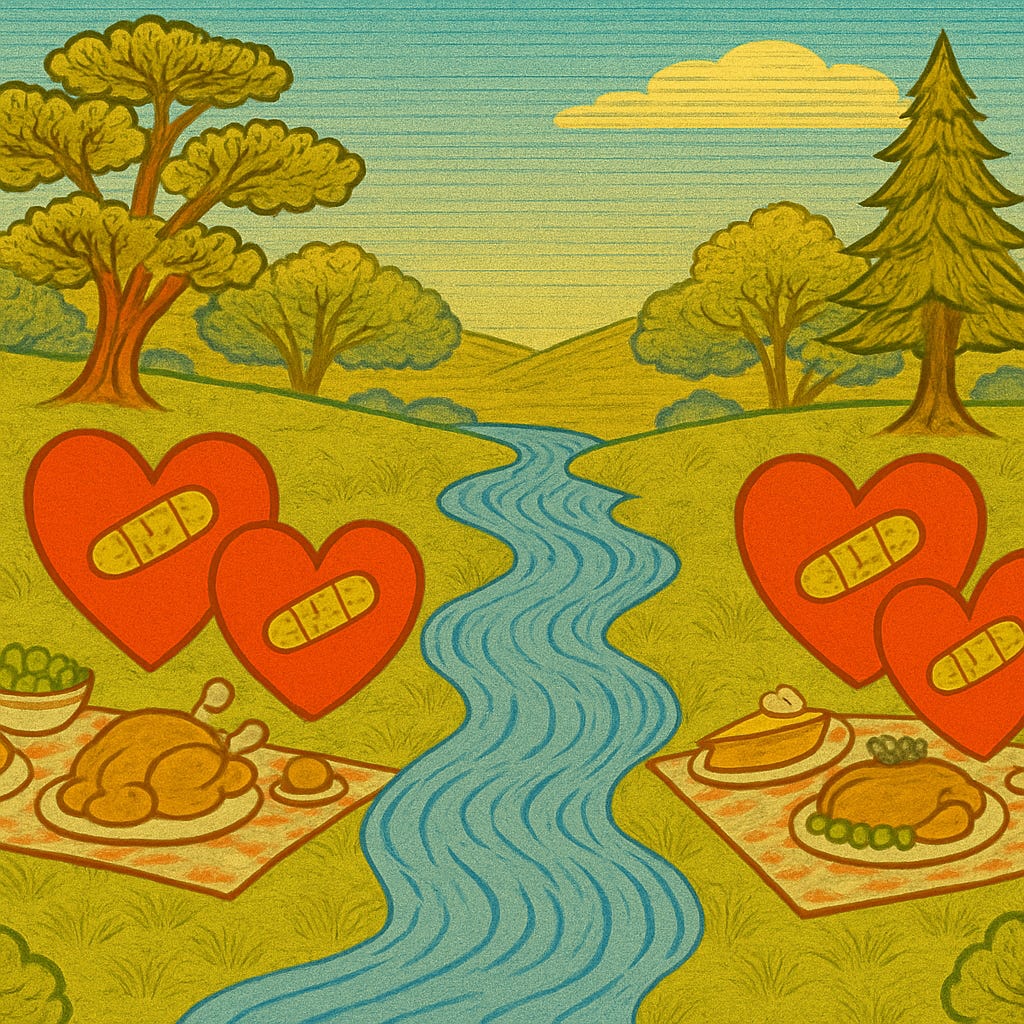
In the modern trend of Friendsgiving, we see tradition carried forward but in a “refresh” to come together without painful family dynamics. This is what your sons are doing with their separate gathering.
When younger generations come together to share food and create rituals, it is both a nod to the parents with whom they celebrated growing up, and the creation of something fresh they can call their own. They bring traditional dishes (sweet potatoes with marshmallows tend to survive every generational cut!) as well as new activities.
By eating the foods of their forebears while sitting at a separate table, they hold connection to their families of origin while forging a new identity. They want a celebration away from unhealthy family roles to express who they are becoming.
A Reframe for Your Thanksgiving
Try to shift your view of your sons’ choices as a condemnation of you, to seeing their wish for a boundary. Without you present, they are hoping to create a tradition that feels freer than how they felt growing up.
But What About You?
Grieving and missing your children is essential to acknowledge, but staying deep in that grief prevents you from creating a holiday you actually want to participate in. It is incredibly hard to let go of the crushing rejection, but if possible, try to hold two truths at once: you can grieve your loss while taking up your own future.
This is a moment where you may be encountering that “inner critic” described earlier. That harsh voice is likely criticizing you for not having done more to “fix” your relationship with your children so that they would want to be with you. It may be noting your lack of success in the efforts you have made.
It is important to recognize this harshness for what it is: an old habit, not the truth. Ask yourself if it is possible to tune into a gentler frequency—a voice that says: “Could I have a nice enough holiday anyway? Can I think of my sons and then set that to the side?” Turning up the volume on the more loving internal voice can be uncomfortable, but it is very much worth trying. Not only do your sons deserve to try having a more emotionally healthy Thanksgiving, but so do you.
See what might be possible for rebooting your own holiday. If you let go of how you thought Thanksgiving would be, and began to imagine new ways to celebrate, what would that look like?
Take a late Fall walk with the dog instead of staying in the house all day cooking.
Host your own “Friendsgiving” with friends in similar situations.
Continue your own old traditions (like watching favorite movies) or start new ones, like that craft project you’ve been meaning to unpack.
These activities celebrate your own connection with your past—perhaps your grandmother knit and you pick up your knitting needles to cast on that sweater project you set aside. This shift could be calming, and it may ironically help your children, too, relieving them of the guilt of leaving you alone.
Pivoting from pain to new territory can be uncomfortable; it can feel like old, rusty gears grinding together. But I like this option better for you than residing in pain without a view of a satisfying future.
Consider this equation:
Loss + Reconfiguring = Growth.
So, Dear Hurt and Lonely,
This holiday, I hope you can acknowledge your pain, set it slightly to the side, and bring some closeness into your day. If you are in the Rough Waters phase of estrangement grief, I hope you can begin to see some Calmer Seas. Glimpsing that view may bring growing pains, but also reward. As a reminder, this may be a holiday where it helps to “Love the one you’re with.” (Thank you, Stephen Stills). And if you are alone, self-care is the best way to love yourself.
Best,
Kathy
I would love to hear from you. Please email me at ksinsheimermft@gmail.com or comment in the Comments section.
This is column # 13.

I can relate to much of what you say. I suspect your words will apply to many families. But there is a missing piece. Boundaries can be healthy and they can be weoponized. Much of current youth culture is in a cycle of angry retribution towards their parents. If the kids are in those circles, they use boundaries to lash out and purposely cause pain to parents because they know how much the holidays mean to that parent.
This may be true for many families, "In our current age of “cut-off,” a Thanksgiving away from you is their attempt to quiet that noise." And it might be worth mentioning that when our kids know us best, they also often know how to hurt us. So for some kids who wish to lash out and intentionally cause pain as "punishment" for not agreeing with their choices, ideologies and beliefs, the holidays may be a way for unhealthy retribution tactics to be inacted.
So parents in both situations of estrangement (one as a way to quiet the noise and one as a way to intentionally hurt the parent) still have to find a way to move on and make the best of the day despite the separation, loss and grief. In other words, the separation at the holidays may be for valid reasons and/or may be to inflict hurt. Perhaps we can ask questions to drill down into the motives for celebrating separately and get to the root of that decision. Once in that space of root cause, perhaps that is where the healing can begin that might bring families together in the future.