

Dear Readers,
Thank you for your warmth, vulnerability, and support throughout our first year together. Your letters and comments continue to shape this space into a compassionate harbor for those navigating profound family rifts.
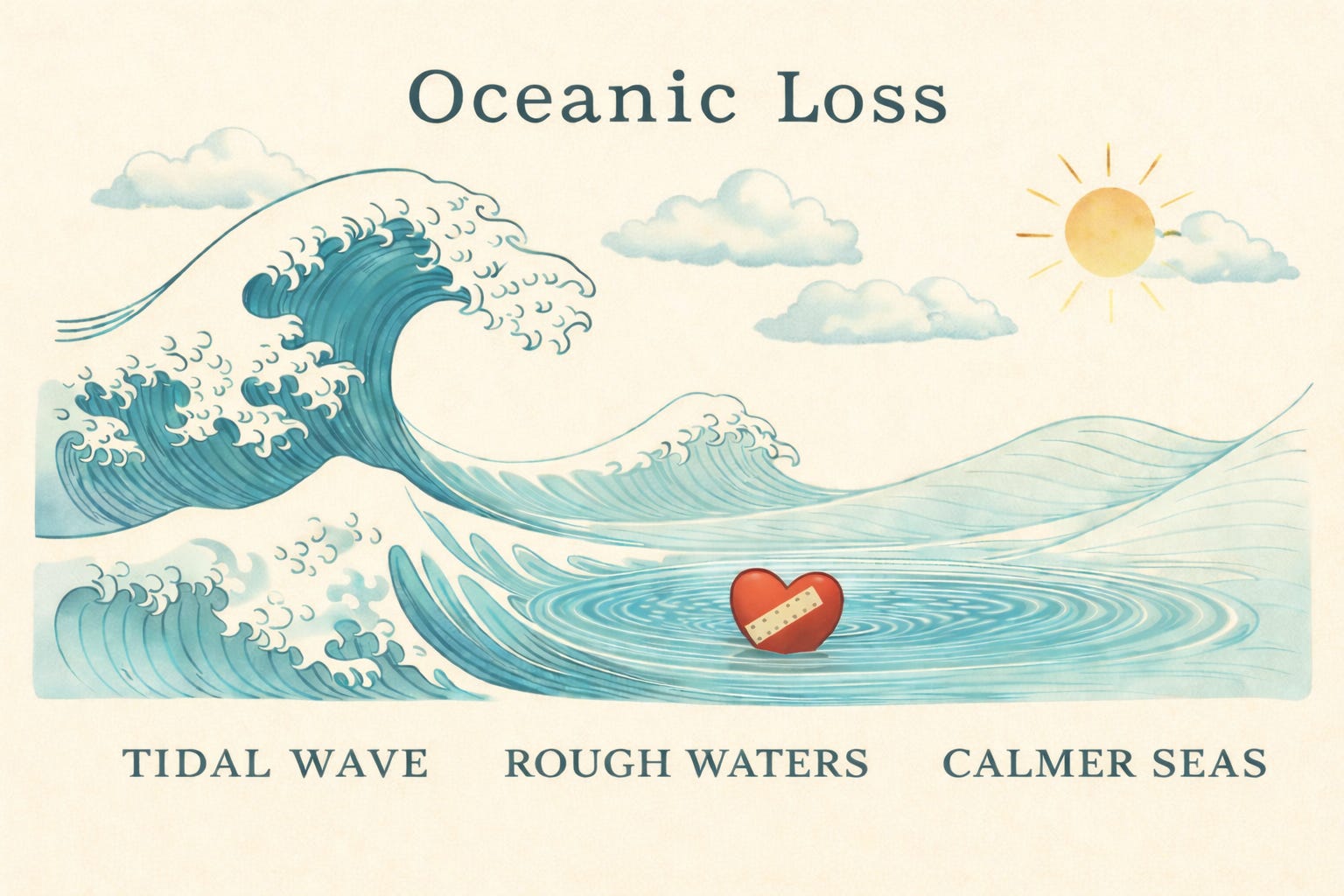
To begin celebrating our first anniversary, (next week!) I am launching a three-part series revisiting the foundational framework of this column: the Oceanic Grief Model.
In moments of acute distress, the Oceanic Grief Model is designed to give you an emotional compass. To help you locate where you are in the stormy seas, find your center, and begin moving toward calmer waters.
My reader asks:
Dear Kathy,
My child has estranged me beyond anything I could have imagined. Even when I am doing my estate planning, and I have questions for her, she wants nothing to do with me—or my money. Not even after I am dead!
How can I stop this painful cycle of finding her in my thoughts, wishing we could be in contact, coming up with what I hope is THE way she will reach back to me, unsuccessfully telling myself to “give it a rest,” feeling hopeless, and ultimately getting frustrated with myself for falling into this well-worn groove?
Please help, if you can!
— Yearning, Missing, Failing, On Repeat and Frustrated

Dear Yearning and Frustrated,
What you describe—finding yourself seeking contact with a loved one who has issued a “no-contact” ban—is painfully common. There are many sources that fuel your yearning:
Your loved one, in this case your child, has been very dear to you. Your heart has a location carved out for her, where she has nestled for many years. A home for her in your heart, as it were. You are attached to her; you have been from the very beginning. This architecture of your heart is permanent. So, step #1 may be to accept that. She is dear to you. Period.
However, she also doesn’t want to be in contact. This is beyond what you had ever imagined—you imagined forever closeness. Your future has been changed by her announcement: NO CONTACT. Not by any means. (And we have a lot these days.)
Here is where your work begins: Your job is to begin to let go. Not because this is what you would ever choose, but because this is your current, only option.
Your mind will argue:
“But I love her so much!” (Yes, you do, and that will make this even harder for you.)
“But she is a member of our family!” (Yes, she is, and she can remain so in your mind. But she may wish to identify herself differently.)
“But she needs my/our support.” (It may seem that way, but she may feel differently.)
“Families are forever. And they are supposed to stick together.” (As humans, we have thought this way for many years. These ideas seem to be undergoing a cultural upheaval.)
“I haven’t had a chance to really work this out with her.” (This is, unfortunately, often the case with estrangement. The silence is deafening, and you keep hoping to speak or even yell through it or past it in order to be heard.)
“It is so frustrating and hurtful to feel this powerless.” (Yes, it is, and here is where the work comes in…)
Exiting Rough Waters?
You are, like our heart in the drawing, currently in Rough Waters. Your seeking, while completely understandable, is keeping you there. You are struggling to accept what you have been shown and told: your child does not want contact, at least for now. Your brain cannot take in that information: What? My child doesn’t want to be in touch? Not imaginable!
I get it, but let’s take another look:
What would it take to imagine it? How could you wrap your head around her wishes, at least for now? And how can you tell your mind and heart to stop searching for her?
In the drawing this week, the heart has his flashlight and safety gear because he cannot stop looking for his loved one. He believes if he seeks long and hard enough—even with the tsunami waves crashing over him—he will spot his loved one with his flashlight and they will reunite in some way. This belief keeps him searching.
In order to feel a little more settled, our heart will need to put down his flashlight. He will need to pivot and find ways to steady himself. If he can seek shallower waters, less in the path of the waves and at least in view of dry land, he may begin to feel a bit calmer.
As author and therapist Lisa Olivera reminds us:
“Grief doesn’t have to be something we fight against; it can become a companion we learn to carry gently as we tend to the rest of our lives.”
How does our heart begin to do that? It’s not as easy as it sounds, but here is where to start:
Suggestions for Turning Down the Searchlight:
Start by realizing you have lost your center.
Let grief be a companion, but not your beacon. Acknowledge its presence without allowing it to direct your every action or keep you scanning the horizon.
Identify parts of yourself that you may have been neglecting in your upset and grief.
Make plans to re-focus on activities where you feel effective.
Observe your effectiveness and take in your pleasure at accomplishing things. Briefly contrast this with where you feel ineffective (i.e., with your loved one). Note the difference and place that awareness in a spot where you can retrieve it when you need it.
Be kind to yourself when your estranged loved one comes to mind, but ask yourself not to dwell there. Yes, you love them very much. They have asked for space, and you are working to provide it.
Develop somatic ways to calm your thinking. Learning to slow your mind, utilizing breathing practices to settle your nervous system, and engaging in movement or exercise are fundamental ways we can process grief while finding our center again.
Cultivate and strengthen the relationships where you do have ongoing contact. Improving your communication and emotional regulation within your active support system honors both yourself and those around you—while preparing you for the possibility of healthy engagement if contact is ever restored.
Focus on valuing yourself and tending to the loved ones with whom shared connection enriches your daily life.
_______________________________
So, Dear Yearning and Frustrated,
It is so understandable that your heart keeps looking for your loved one. You love her; she has a home in your heart; your heart doesn’t understand why she doesn’t want to come home.
For now, your hurting heart needs other sorts of tending: love from you and those near you who can actively provide warmth and companionship.
Early on in my columns, I found myself quoting the singer/songwriter Stephen Stills several times: “Love the one you’re with”. I think, as Dear Estranged completes its first cycle around the sun, we are back there. And it’s good advice!
Best,
Kathy
Please reach out to me in the Comments Section or at ksinsheimermft@gmail.com
This is column #52
I can stop thinking about our ED for short periods of time but not about our two granddaughters that we can’t see or have contact with. We helped raise them and everything reminds us of them. We are the only ones cut off. When will it stop hurting so bad?
My 47 year old son has been no contact for three years except for bi-annual texts to either say happy birthday or I hate you. For two years I responded in kindness and waited. Finally, I responded by saying I love you and would be open to a conversation whenever you are ready. His response was a confusing angry rambling that made clear that he wants nothing to do with us. That was mother's day 2025. We havent heard from him since, and I'm ok. We have an appointment with our lawyer to modify our will. It's time to move on. Three years is long enough to grieve. This is his thing.