

Dear Kathy,
Six months ago, my close friendship of many years ended in a note on a card. We had a pet name we called each other. Over the years, we always started our cards “Dear (pet name).” This card began “Dear (my real name).” We’ve processed things over the years, and I thought we were doing a good job of airing our differences. In the card, she ended our friendship and asked me not to contact her. My heart hurts. I’ve been working with the pain, and it’s gotten better, but sometimes, Yikes!
A meditation column I subscribe to suggests that friendship loss is a growth opportunity—that every moment of growth is also a small death as you leave something behind. Can you help me see how to take some of those small steps while grieving? I might be stuck.
Shocked, Grieving, and a Little Curious
Dear Shocked, Grieving, and Curious,
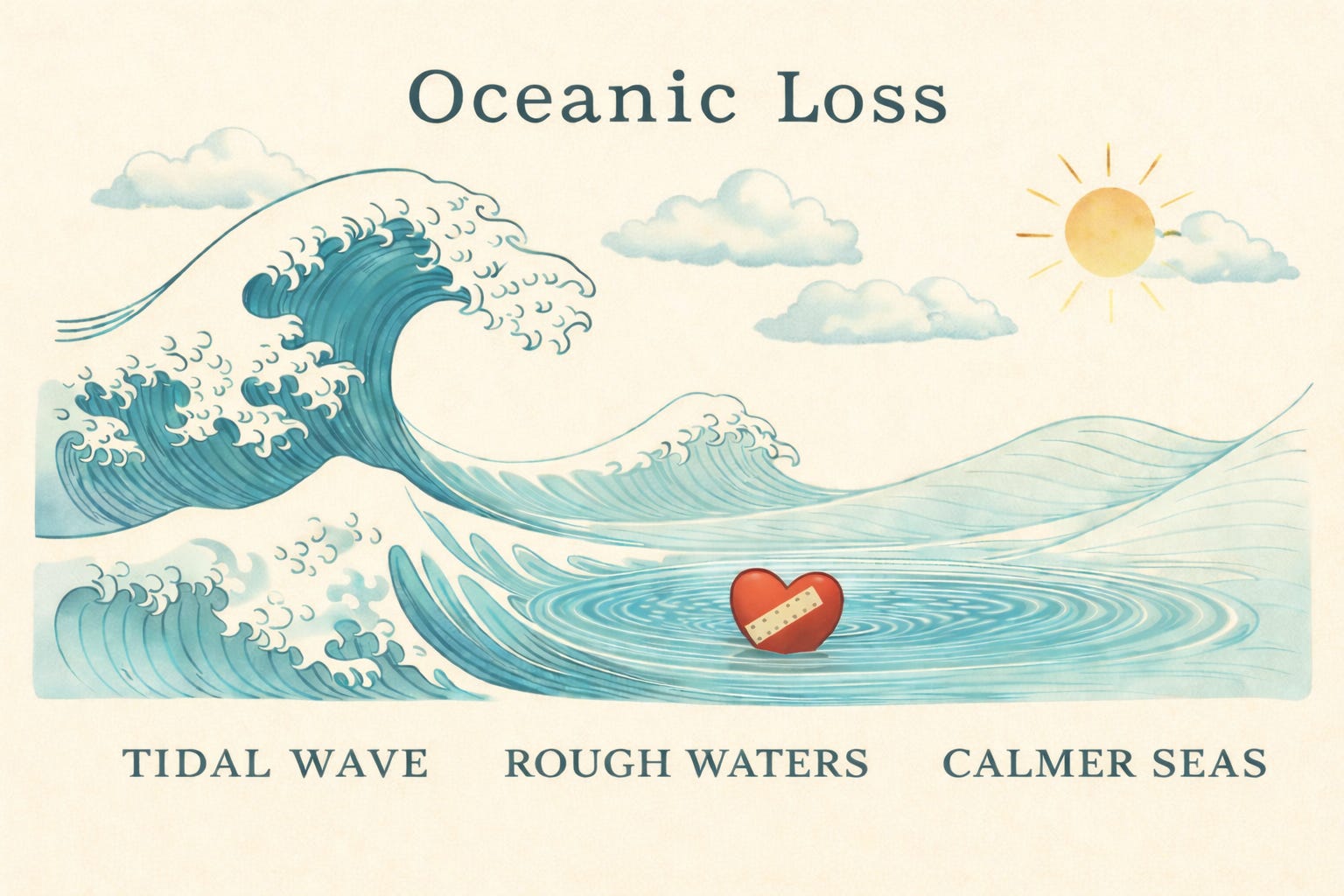
I’m so sorry to hear about the loss of your friendship. Your friend couldn’t keep working on the relationship problems with you, and gave up your friendship instead. In my Oceanic Loss model, you are past the Tidal Wave (the shock phase) and are currently in Rough Waters. Several of Elisabeth Kübler-Ross’s phases of grief apply here; you are no longer in Denial, but you may very well be experiencing Anger and Depression as you struggle toward Acceptance.
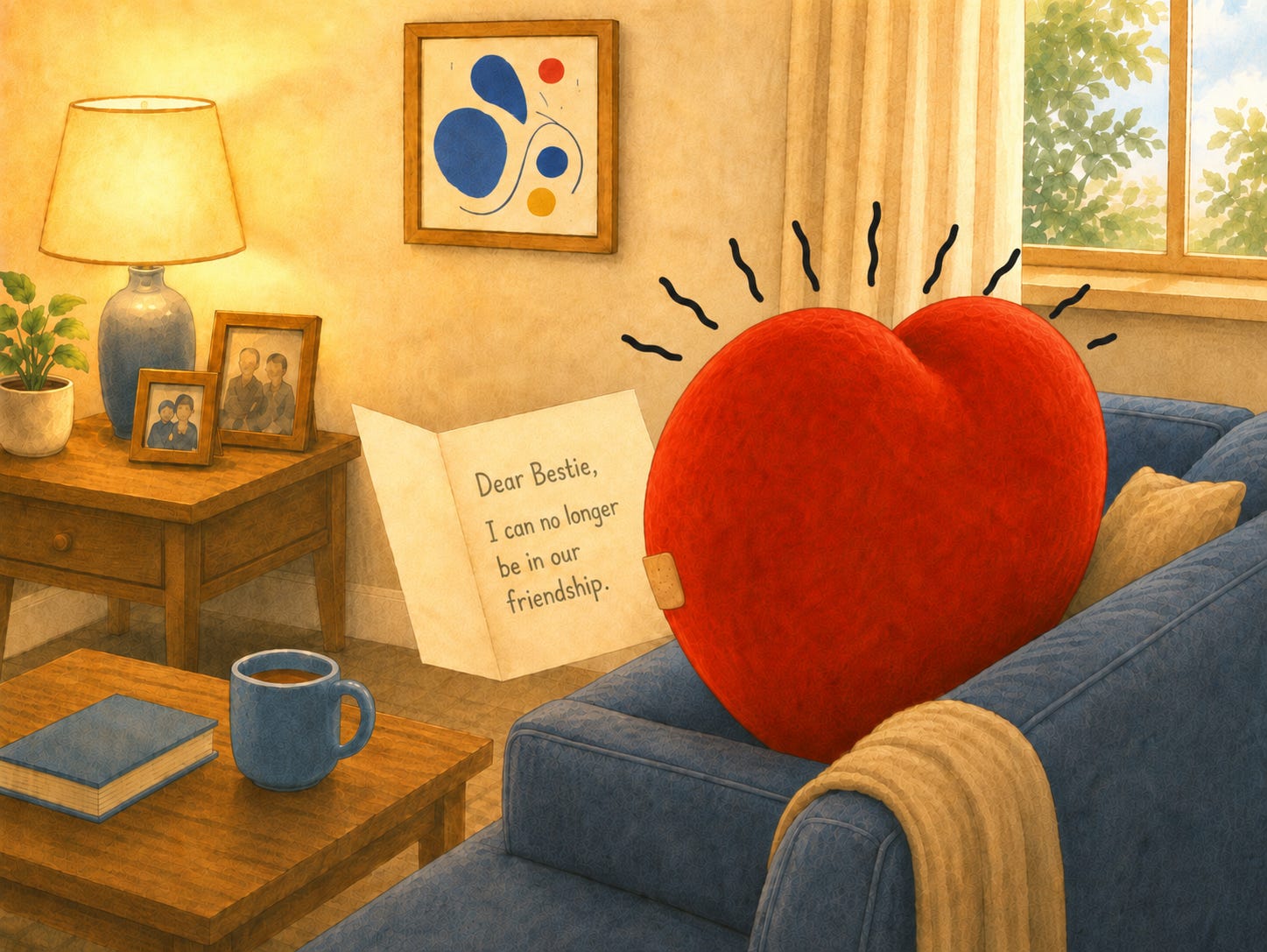
Accepting estrangement is very challenging. You’re accepting the absence of someone who is very much alive—an experience that is incredibly different from accepting the loss of someone who has died. Their choice to estrange you is deeply hurtful because it is a form of rejection. When we are rejected, we feel devalued, dismissed, unwanted.
A very small version of this is when someone gives us the Silent Treatment. The silent one acts as if you are not worth their attention or conversation, but they remain nearby. Their silence serves as a protest over your behavior. As the recipient of the silent treatment, you know that—even though it can sometimes feel like a long silence—it is temporary. In estrangement, your loved one takes themselves away not temporarily, but in a manner that seems permanent.
Your friend couldn’t find a way to successfully share with you what she wanted you to know was wrong. I don’t know if she tried or she didn’t, but ultimately, she felt she couldn’t convey what she wanted to, so she stepped away. In a long life, I wonder if almost everyone winds up on one side or the other of this experience at least once. Having to leave someone because you can’t communicate what you feel you need to can be very painful. Being left because communication has failed is reciprocally painful. No one comes out a winner.
Friendship Breakup Hurts!
Last year, I was close to a friend breakup. I will call the friends “Susan” and “Maddy.” They were very close, exchanging messages daily and serving as an important part of each other’s support systems. For Susan, something had shifted in their relationship—she felt Maddy had become inexplicably aggressive towards her. No amount of trying to talk together conveyed how Susan felt Maddy was mistreating her.
When Maddy couldn’t take in Susan’s concerns, Susan explained she had to take a break in the friendship until she felt Maddy could stop being aggressive. Susan was devastated. Their friendship was deeply meaningful and now taking a break was her only option. Their break has become more-or-less permanent, as the communication impasse continued.
The breakup has been deeply painful for both of them. Maddy has been hurt, and Susan is in pain as well, missing Maddy and experiencing her frustration at not being understood. I think when we are the rejected one, it can be difficult to realize that the rejecting one could be feeling awful as well. I promise neither side feels good.
I hope it helps to hear that friends go through this. It must have hurt not to see your pet name on your friend’s card. I am guessing she felt a kind of powerlessness in your friendship dynamic and was trying to regain a sense of control. If she wrote your given name and not your pet name, she could gain a sense of distance. (I often find a parallel dynamic where estranged adult children call their parents by their first names. I think they are trying to re-identify their parents as ordinary humans, to remove them from their key parental role.) It probably seemed like your friend took the upper hand, but more likely she was trying to get a grip on a ledge in order not to fall.
Breakup is a Growth Opportunity? You Have to be Kidding Me!
Of course at first, when we are rejected, we don’t think: This is a growth opportunity! My friend has dumped me and I want to grow! (Ugh!) But we can try to get there.
“Every becoming is built on a small dying.” — From Meditate with Heart
In other words, when you are in pain, the energy of that pain could start a small fire in you that helps you grow through and then beyond the pain.
How IS this a growth opportunity? Take time to examine how your friendship was working for you, as well. Were there things you wanted to flag but couldn’t figure out how? Could there have been a way you were outgrowing the friendship and were unaware? Had you recreated unhealthy patterns from your earlier family life that you wanted to change?
For example, we may find ourselves reenacting relationship dynamics from growing up. Susan and Maddy had a power dynamic in their relationship modeled on their earlier family lives. Susan was a little afraid of Maddy. Maddy brought a need for power into the relationship, and for quite a while, Susan complied, trying to please Maddy to keep her happy and preserve their friendship. These roles were familiar, and worked until something shifted.
It’s possible Susan had become less amenable to placating Maddy, and this had caused Maddy to up the ante—to be more aggressive, hoping to reassert her power. This made Susan even less willing, leading to her pulling away. Enacting their dynamics from their own families initially brought them together because they were familiar. Later, fatigue with playing these roles led to the dissolution of their relationship.
She Won’t Communicate—What Do I Do?
You have been silenced in your friendship—a place no one likes.
What to do? Try journaling. You have not been silenced to yourself. Write what you would have liked to say. What you would have liked to work out. What you wanted to make understood that you couldn’t.
As you reach beyond that friendship loss to create new opportunities for closeness, one thing you will see is how you may have relied upon that friend in areas of both strength and weakness. There may be ways you have grown beyond your friend that you only see as you step into a future without her. Perhaps when you had a particular type of problem, you always took it to her, almost reflexively. Without her, what do you notice? You may find that you actually have learned and can problem-solve on your own some of the time. You may find that others have good ideas to help you with difficulties in ways that are unexpected. There may be new people that you want to know, or people who have been more peripheral in your life that you want to know better—all of whom can enrich your life now that you are looking at the world differently.
Two things are key here:
Your friendship was valuable and important to you. It can still be in your heart and memory. In a way, your friend lives inside you and will always be there.
There are people in your life who want to know you and support you. When you look at them with fresh eyes, you will find opportunities for new, enriching connections that you hadn’t seen before.
Ways to Reframe
You didn’t volunteer for this growth opportunity, but embrace it. Estrangement is a deeply painful human experience. Looking for ways to grow within your estrangement will help you process and move forward.
Journal to memorialize: Write about your friendship in valuing ways to honor the genuine good that it held.
Talk with trusted friends: Allow yourself to be angry and let others support you in that anger. But also remember to hold space for the value of what you once had with each other.
Create a small ceremony: Value your lost friendship with a personal ritual. This is a way to complete your old chapter and to intentionally begin a new one.
Honor your history: That friendship will always be important and meaningful to you, even as you move on. Be as respectful of the friendship and your feelings of loss as you can be.
Build a stepping stone: Finding a way to let the loss be a catalyst for self-discovery values both you and the journey you shared.
_______________
So, Dear Shocked, Grieving and Curious,
Your heart hurts at the loss of your deep, long friendship. There is extra sting because you were rejected by your friend. It seemed like she gave up instead of trying to work things out. Of course that is hurtful, as if you were being dismissed. My sense is that your friend didn’t have the capacity to let you know what she hoped to convey to you, and instead circled her wagons. This is a loss for both of you—you couldn’t have the difficult but generative conversations your friendship needed. You would have tried if you had been given the opportunity.
My wish for you is that your stepping stone emerges as the swirling waters subside. And that your growth from your loss serves you well as you offer your heart connection to lucky others in your future human connections.
Best,
Kathy
P.S. If you want to practice moving through these stuck places together, I’m presenting a workshop on August 1 with Ann Dyer, the founder of Mountain Yoga. We’ll gather in Oakland and on Zoom for an afternoon of gentle yoga, journaling, and talking through how estrangement lives in the body. You can find more info and reserve your spot here: https://www.m-yoga.org/living-with-estrangement.html
Please reach out to me in the Comments Section or at ksinsheimermft@gmail.com
This is column #41
As I was reading this, I found myself thinking virtually every person I know has been involved in some variation of this friend estrangement - and ever more so with the popularization of “ghosting.” So great that people at least now have a knowing, supportive voice to turn to at Dear Estranged.
Excellent!