

Dear Kathy,
I have read that there are a higher % of divorced families where the adult child is estranged than if their parents hadn’t divorced. Why do you think that is happening? When our family came apart, we just couldn’t make it work. Then, we had a conflictual divorce. One of our children stopped being able to go back and forth between our two houses. I tried to help her keep seeing the other parent—we even went to therapy. Now my child is estranged from me. I hate to be a statistic when I was actually trying to save our children from the ongoing conflict my partner and I were having. And the divorce was really hard.
Now this?
— Confused, Disappointed and Wishing it Weren’t So
Dear Confused, Disappointed and Wishing,
I am sorry to hear that your efforts to save your family from high level stress in your home led to a conflictual divorce, and to a rupture in your child’s relationship with their other parent. And now, this history may have contributed to that same child estranging you! Reading what I just wrote makes me wonder if your adult life has felt like a series of connections and separations in your relationships. And, when it’s one of your children, that deeply stings.

Unfortunately, all family members suffer in divorce. When we divorce, we hope to reduce suffering, but it can be very painful to make it to the other side. Children suffer from the disruption of their home lives. They were used to one house and now they are supposed to live in two. They were used to both parents being at home, and then they only saw one parent at a time. When parents are fighting, sometimes children feel pulled to take sides. That side-taking can result in court battles if the child is unwilling to even see the other parent. Court battles make divorce last even longer, and cause even more financial strain.
Divorce is hard, and I want to be sure to say clearly that I know it must have been hard for you. The rest of this column will look at your question of how your divorce might have led to being part of that estrangement statistic you asked about in your letter.
Children make accommodations to divorce: living in 2 homes, being without one parent while living with the other can be hard on young children. Once, a pair of 9 and 10-year-old brothers told me they missed the other parent at first, but then they “got good at it.” Some children have more trouble than those brothers. Sometimes they can’t make the adjustment and refuse to follow the custody plan, like in your family. I think these kids feel that the only way to keep themselves going in the divorce is to opt out. They enact their own plans instead of following the parents’ plans. They opt to stay at one home. Sometimes they won’t see the other parent at all. This is hard on everyone, but it is the child’s way of coping. Therapy can be helpful at this point, and you did that.
Now, your child is an adult and the living arrangements are different. They are in charge of their own lives and make decisions about who to see and how much to see them. Here is how childhood experience with divorce may contribute at this point:
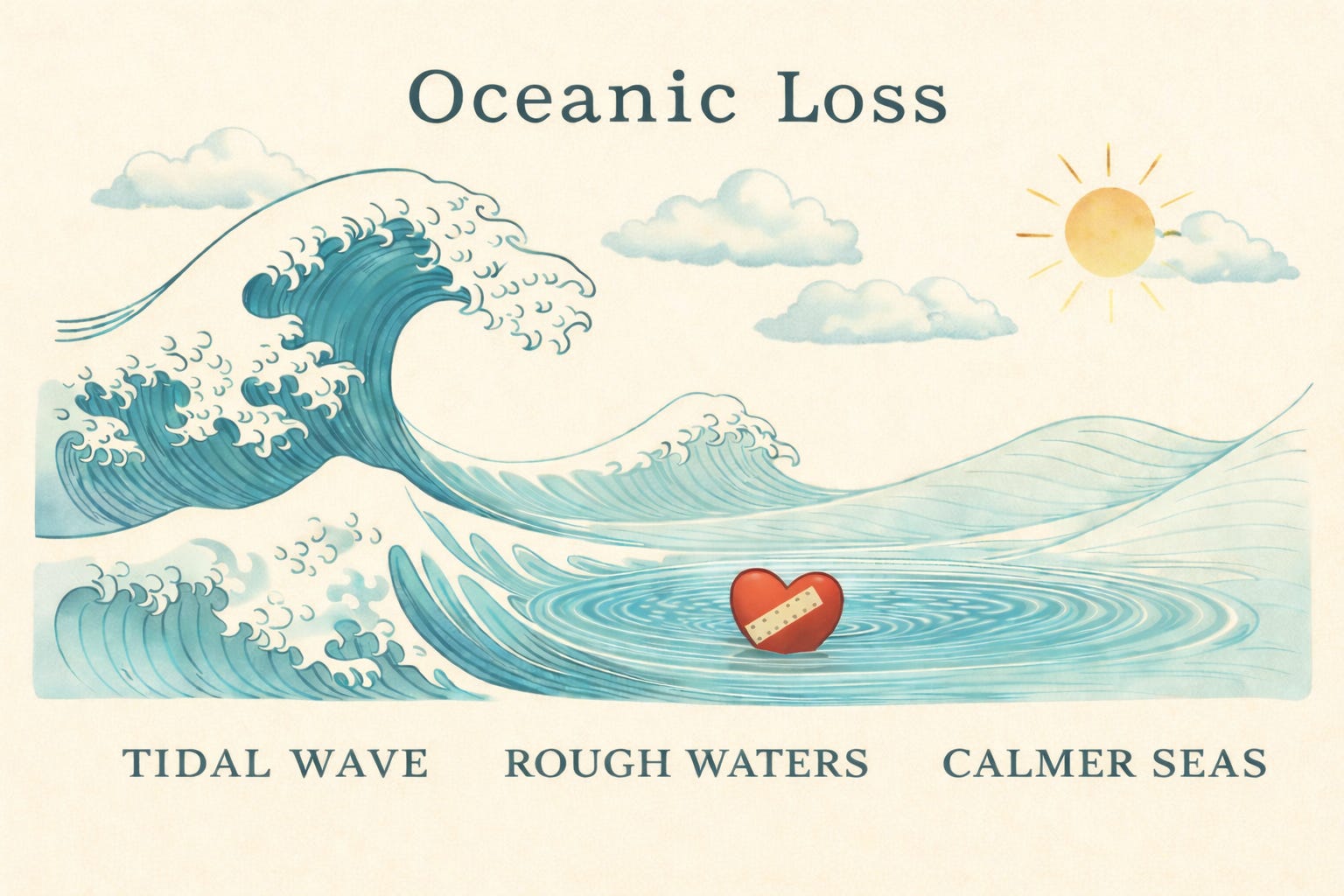
Children who have experienced divorce have learned that sometimes when people have big enough difficulties, they have to separate. That you can let go of someone who has been significantly important to you if you aren’t doing well enough together. Sometimes children wind up living with a newly configured family if their parent re-partners. That is something they learn how to do too, as best they can. Skills of adaptation can be learned in this environment, but it can also lead to a deep longing for choices over who you live with and relate to. And, once you are an adult, it can lead to you wanting to make choices about the degree and intensity of contact with formerly close family members—sometimes feeling that need to make the choice pretty intensely. Like the heart turning away in the drawing, it is a way to keep the wound safe. Sometimes, this can lead to a period of estrangement.
I think part of what’s really hard, here, is that you, the parent, were trying to make life better for yourself and your children. You thought that leaving your high-conflict relationship would ultimately give all of you a more peaceful and productive family life. You didn’t mean to hurt your children—you meant to make things better for everybody. And now you are estranged!
This is the last thing you would have wanted. Sometimes parents in your situation tell me that they were formerly very close to the child who has estranged. When you were divorcing and for some time after, this closeness may have felt like security for your child, and it possibly felt to you as a reassurance that you had done the right thing.
Divorce can lead to some children feeling increasingly independent early on as they manage their lives between two households. But for others, that intense dependency on you seems like the only protection from the shifting foundation of the family. Psychic muscle development takes time. Now that your child is grown, they may feel needs for independence that they couldn’t feel or actualize before, but have the capacity to enact now. When grown enough, that more dependent child may suddenly initiate a strong push away to accomplish those postponed developmental tasks that need their attention. They may feel they need to take on these tasks completely on their own, in order for the accomplishment to be truly theirs.
Self-Care, as You Accept the Possibility that You are an Estrangement Statistic
Be thoughtful about reviewing the history of your marriage, separation, and divorce. Divorce is difficult in innumerable ways, and these may come up as you review the past. Painful memories and negative thoughts about your choices will likely arise in your “retrospectiscope”—that rearview mirror of hindsight that can shows us our past, colored with emotion and the passage of time. As you go over this history, please be as kind and gentle with yourself as you are able. That being said, if you can learn something that is useful for the future—if you can picture more from your child’s perspective—it may help you develop a more current understanding of your adult child.
Sometimes, when remembering, it adds color to include information from your own life history. How your childhood led you to your choice of partner, and how that led to you having children with your partner but also to your divorce. Compassion for your own history, your possible missteps, fissures as well as growth—is key to making it through life, including making peace with your divorce.
Accepting the long-term fallout of divorce is painful but helpful. You needed to divorce your partner, and you saw it as better for the family. It turned out that it was really hard for all of you, and may be a contributor to your current estrangement. This is not what you wanted, at all, but it is what is happening. See if you can accept your child’s need to estrange and know that divorce may be a factor in the estrangement. This could be painful, but might ease some of your discomfort as you navigate your way through the current distance your child has brought to your relationship.
Self-care is essential. Continue to find and make use of the best ways to care for yourself as you travel the rocky terrain of your estrangement. Processing your estrangement could include a chapter where you sift through your divorce for clues. This makes sense, but be careful not to see it as an opportunity to beat yourself up. There is enough pain in your situation as it is—it would be kindest if you did not inflict even more upon yourself.
________________________
So, Dear Wishing,
You asked, “Now this?” We will never know if or what your divorce has contributed to your estrangement. Reviewing your divorce history may help you think more about this question.
To be clear, I am not telling you this is something you need to do. I am guessing that, since you asked the question, you have already started to wonder, and this can lead to deep excavation, so I am simply saying: while taking accountability, be compassionate with yourself in that process.
Wishing you the best on this part of your journey,
Kathy
P.S. If you want to practice moving through these stuck places together, I’m presenting a workshop on August 1 with Ann Dyer, the founder of Mountain Yoga. We’ll gather in Oakland and on Zoom for an afternoon of gentle yoga, journaling, and talking through how estrangement lives in the body. You can find more info and reserve your spot here: https://www.m-yoga.org/living-with-estrangement.html
Please contact me through the Comments section or email me at ksinsheimermft@gmail.com
This is column # 39
My situation is similar, but the divorce happened after the adult child estrangement. I’ve yet to see this situation addressed. Wondering how common this is. It doesn’t change the effect of estrangement, but what I’ve learned through my experience is that it took the estrangement for me to finally get the courage to leave that coercive controlling man.