

Dear Kathy,
My sibling and I have taken a trip together every fall to see the leaves turn. When I started our planning for this year, she was vague about dates. I haven’t been able to get her to commit, and now she is not responding to my requests. She says nothing is wrong, but I am sure something is. She isn’t a great communicator, and telling me something isn’t right would be hard for her.
I’m frightened she is ending our sibling relationship—I almost said friendship, because it is that, too. And that she won’t tell me why.
I’ve been in emotional free-fall. I’m afraid we won’t have our trip; she is “scrubbing” our relationship, and that I will never know why.
Please help me think about this differently—I’m drowning!
— Scared, Mad, and Heartbroken
Dear Scared, Mad, and Heartbroken,
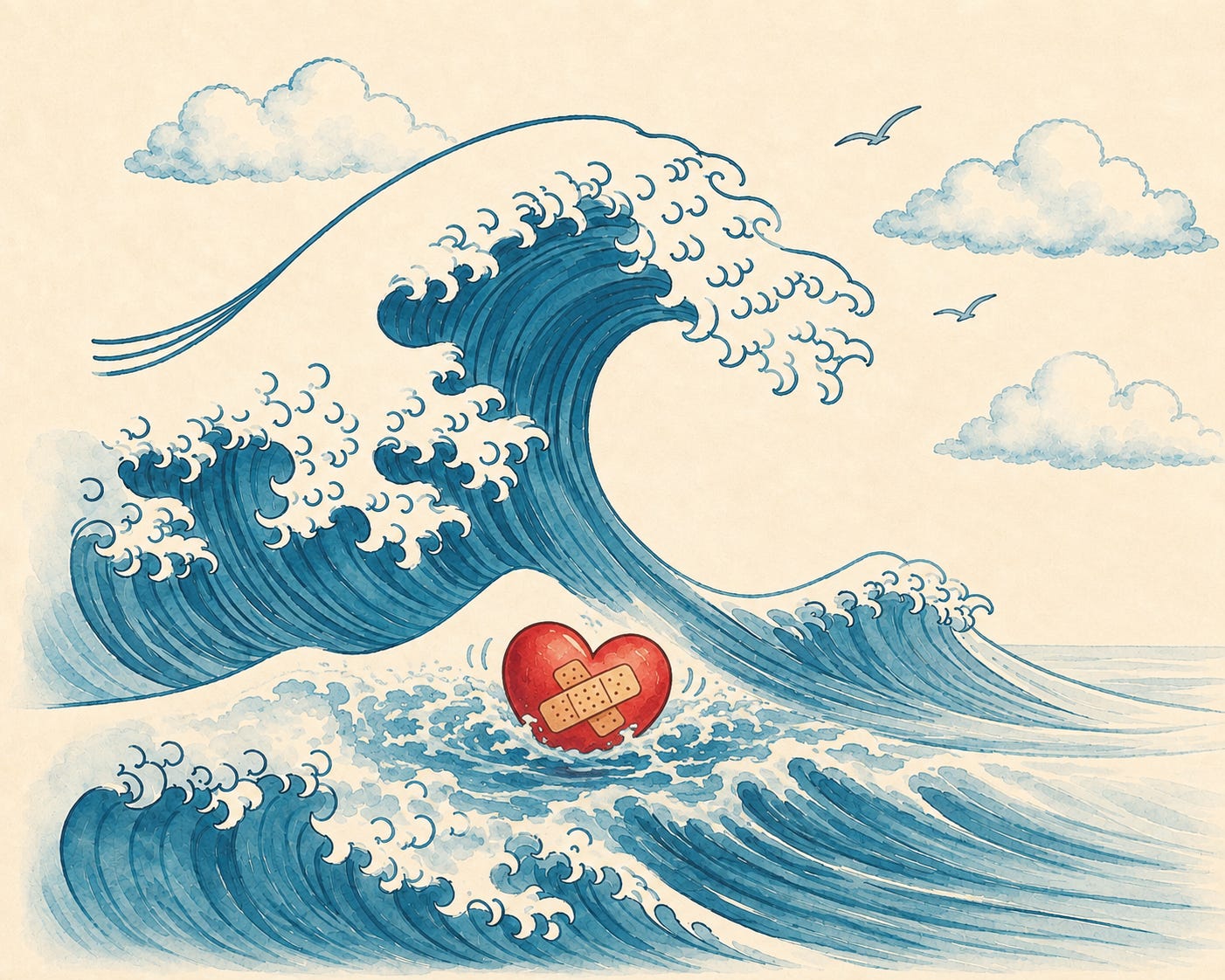
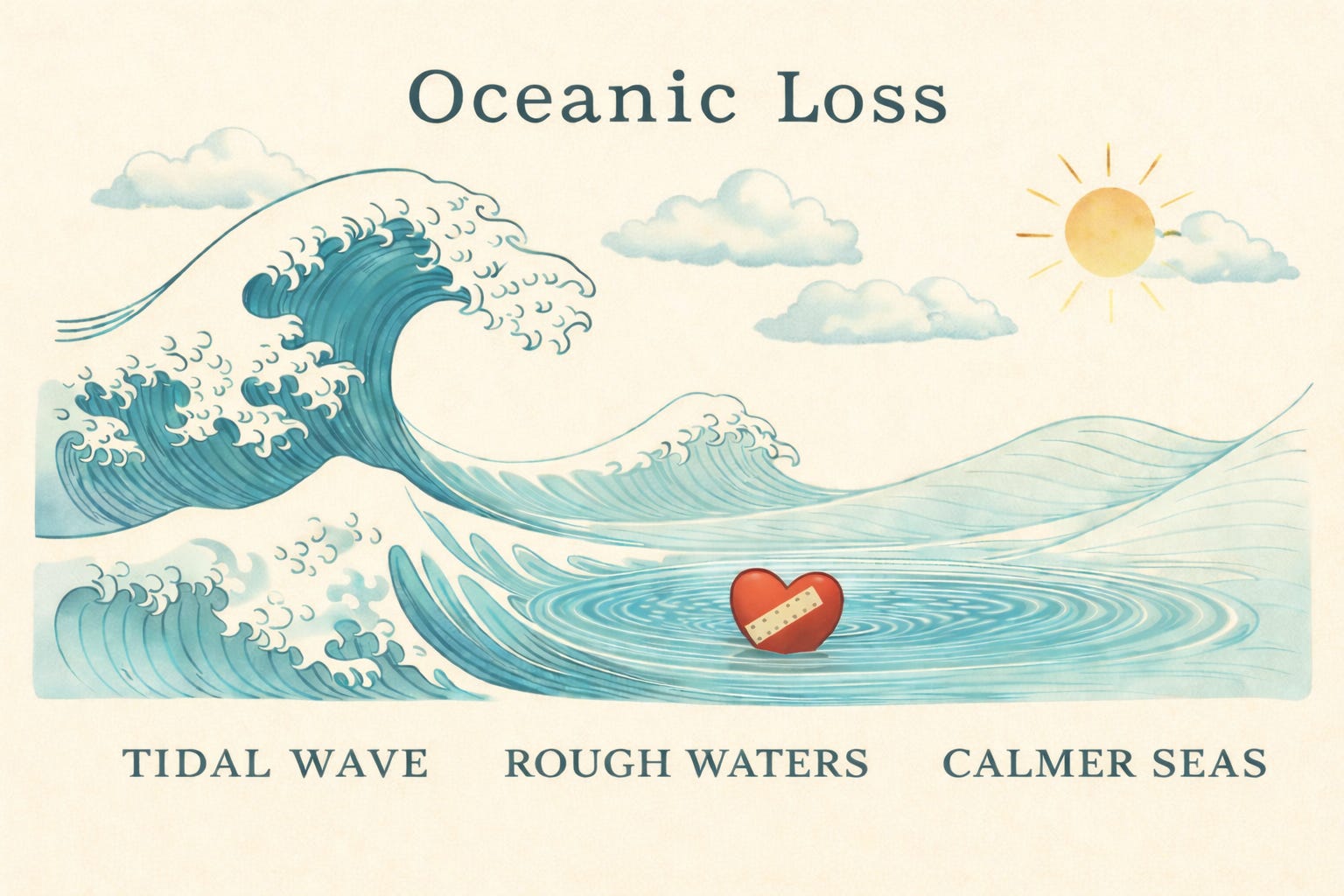
We are in part 2 of our 3-part series reviewing my Oceanic Loss model in honor of Dear Estranged’s first birthday. I chose your letter this week because it perfectly describes the pain of being caught in the Tidal Wave phase of Oceanic Loss. When communication suddenly dries up, you are tossed into emotional free-fall—unable to tell up from down, and barely able to catch your breath.
While Oceanic Loss can be progressive, it isn’t always a straight line from storm to calm. In the drawing of the model below, you will see the massive Tidal Wave on the left and a whirlpool right in the center of the Rough Waters. That vortex provides context and perspective: even as you begin moving toward Calmer Seas, grief can swirl you back up at any moment. A change in tone, an unreturned message, or an approaching seasonal tradition can pull you into the spin. Recognizing the whirlpool helps you see that you aren’t failing to heal; you are simply navigating the non-linear currents of relational loss.
Your Heart Will Hurt
An unavoidable truth of estrangement loss is that your heart will hurt. Someone you love deeply has stepped away from you and has reduced or cut off contact. The suddenness is shocking and throws you into the depths of the ocean of grief, with what feel like huge waves all around. You didn’t see this coming, you feel shocked, overwhelmed, suddenly bereft, disoriented, panic-y, and hopeless. This flies in the face of what you felt was true, at times making you doubt the history with your loved other as you remember it.
The place in your heart where that relationship lived and where your attachment lives feels ripped open.
“Heartbreak is what happens when love is lost or when a connection is severed. It is an involuntary yearning for wholeness, and grief requires us to reorient ourselves to every part of our physical, emotional, and social worlds.”
— Brené Brown
You feel ongoing hurt, possibly unlike any hurt you have known before. Your loss of control over any contact is deeply painful and can even be frightening, because all attachment brings with it a desire to be able to locate your beloved other. And when contact is reduced or cut off, your body registers that silence as a physical alarm.
Where to begin with a suddenly hurt heart?
Recognize you are in the Tidal Wave: Accept that right now, you are being tossed around by acute fear and heartbreak.
Acknowledge your lack of control: Recognize that you may be powerless to do or change anything in your relationship at this time.
Sit with the discomfort: Allow yourself to be in this uncomfortable place without immediately trying to force a resolution.
Accept the current ambiguity: Work with yourself to take in the reality of the present moment, even while it feels unfair and unresolved.
What next?
Express the unsaid: Identify a way you can privately record your thoughts—a practice of talking (leaving yourself a voice memo), journaling uncensored, or making art to give healthy expression to your raw feelings. Your loved one can’t/won’ hear you right now, but it is important for you that you express yourself!
Pause your pursuit: Step back from repeatedly asking for dates; give her silence some room so you aren’t feeding your own anxiety vortex.
Explore somatic, self-calming practices: Engage in simple grounding practices—feeling your feet flat on the floor, lengthening your exhales, or gentle movement—to calm your nervous system when panic spikes. I have started sharing one of these practices each week with an accompanying video; see if those resonate with you, or search elsewhere for what suits you best.
Refocus your energies: When you are ready, re-center your attention on areas of your life and relationships where you feel valued, reciprocated, and able to contribute.
Center yourself regularly: Practice small, steadying rituals throughout the day to help you stay more even-keeled through the loss.
_______________________
So, Dear Scared, Mad, and Heartbroken,
Your heart is hurting like crazy right now. I am so sorry, and I get it. It hurts that your sister can’t be more direct, leaving you bewildered, sad, and upset.
Please talk with supportive others about the best way to handle your fall trip to see the leaves (Should you still go? Better not to, to avoid the hurt feelings you will no doubt have?).
Allow yourself to feel the real pain of this silence, and see if there is a gentle way to ask for a conversation when the dust settles. In the meantime, love yourself as best you can, and be sure that others who love you remind you of their love and support.
Warmly,
Kathy
Please reach out to me in the Chat, Comments Section or at ksinsheimermft@gmail.com
This is column #53
(Happy Birthday, Dear Estranged!)
This resonates with me. My older sister and I have been estranged for years. We have very limited contact, which saddens me, but I don't know how to resolve it as I believe it stems from childhood trauma that we both experienced. Below is a post I wrote about it.
https://leener.substack.com/p/soul-sisters