Dear Kathy,
“I am following my sibling’s ‘request’ (it felt like an order) to go to therapy to work out my ‘shit’ (!) so that we can stop being estranged. I found a therapist to talk with, and what I discovered is that looking at myself is pretty painful. The other day, I actually said ‘Ouch’ out loud to something that my therapist had said.
Why is it so uncomfortable to look at myself? No wonder people don’t want to go to therapy!
Reluctant Participant !!
Dear Reluctant Participant,
First, I want to offer you my admiration for hanging in there with your therapy.
It takes immense courage to sit in that chair, mostly against your will, expecting to be declared totally in the wrong. That you were able to let your therapist’s observation land, and were honest enough to say “Ouch!”, bodes remarkably well for your growth.
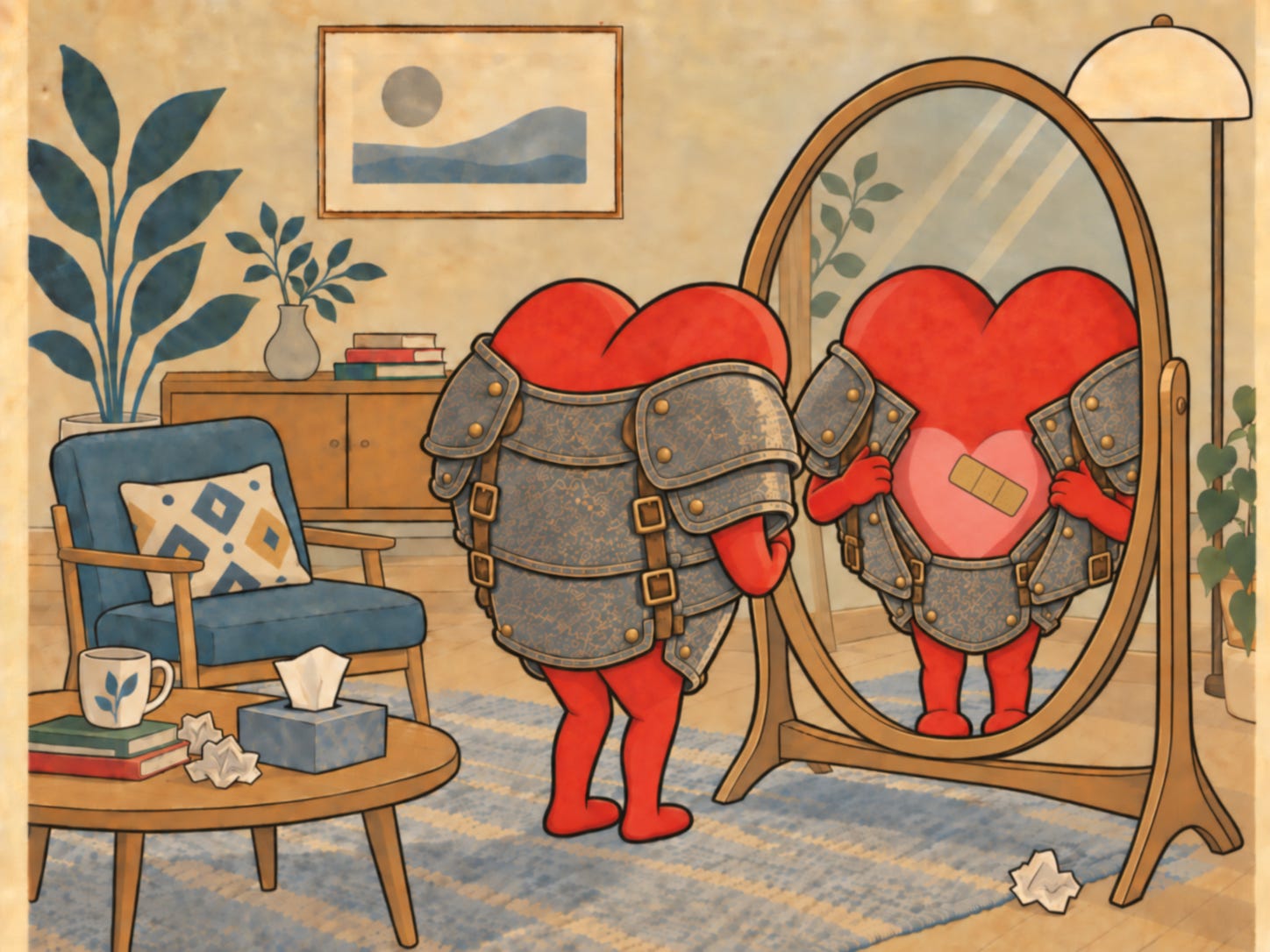
Your “ouch” means you were able to acknowledge something true and painful about yourself without too much of a fight. That is not easy, at all, but it is where real transformation begins.
“The most difficult times for many of us are the ones we give ourselves to look into the mirror.”
— Pema Chödrön
Nobody feels good taking in something that feels critical. We are wired to defend ourselves, and as we grow up, our inner alarm gets calibrated for when to go off and how loudly. In everyday life, an accurate observation can feel quite uncomfortable; in therapy, it can feel like a direct threat to the psychological armor we developed to stay safe.
When you begin to lower that protection, the sting can be sharp—not because you are defective, but because you are touching tender territory:
The shock of dropping your public persona. We have all constructed a version of ourselves to present to the world. Loosening that persona to look at our more subtle “operating instructions” is uncomfortable and not something we often do. We are revealing parts of ourselves we wish were different or cause us shame. If a therapist shows us something about our patterns that we haven’t seen before, that realization will usually land with a force.
The gap between intention and impact. Seeing that our fiercest, most loving efforts may have had a different outcome than we hoped for can be staggering. Holding both realities at once—“As your sibling, I tried to love you with everything I had” and “the way I did that also caused you strain and pain”—is humbling but ultimately beneficial work.
How do we move from merely enduring our discomfort to actually tolerating, and perhaps even welcoming, the unfolding of who we are?
Shift from an autopsy to an archaeological dig. An autopsy hunts for what went wrong and who is to blame. An excavation gently brushes away dust to uncover artifacts of how you survived and developed. When you spot a defense or a blind spot, see if you can greet it with compassion instead of contempt: “Look at how hard that part of me worked to keep me safe.” Seeing your patterns as survival strategies makes self-discovery more illuminating, less humiliating.
Savor the energy you get back. Maintaining an airtight image takes a huge amount of fuel. The moment you admit, “Yes, I can become controlling when I’m afraid of being abandoned,” you no longer have to spend precious energy keeping everything in order or having to be right all the time. Whew!
Your insight can be a benefit, not a verdict. Looking inward can feel like hiring a judge. Instead, it is about befriending the tender heart beneath your armor. When you realize that your new awareness belongs entirely to you—and that the reward is your own hard-earned clarity of mind—the process can feel less like punishment and more like coming home.
______________________________________
Thank you for your honesty about the roughness of self-reflection. When what you see in the mirror feels sharp, remember to bring compassion to what aches. You are tender because you are healing.
Kathy
Please reach out to me in the Chat, Comments Section or at ksinsheimermft@gmail.com
This is column #55