Dear Kathy,
My estrangement is SO deeply painful. How can I live with my loss while still putting one foot in front of the other? I don’t want to forget the ache—in truth I can’t—yet I want to stop being consumed by it. How do I bear this while I try to live my life?
— Hurting, wondering, trying to live
Dear Wondering,
You aren’t asking how to cure the pain, and you are not asking how to build a wall around it so you never have to feel it again. You are asking how to coexist with it. This is a thoughtful beginning.
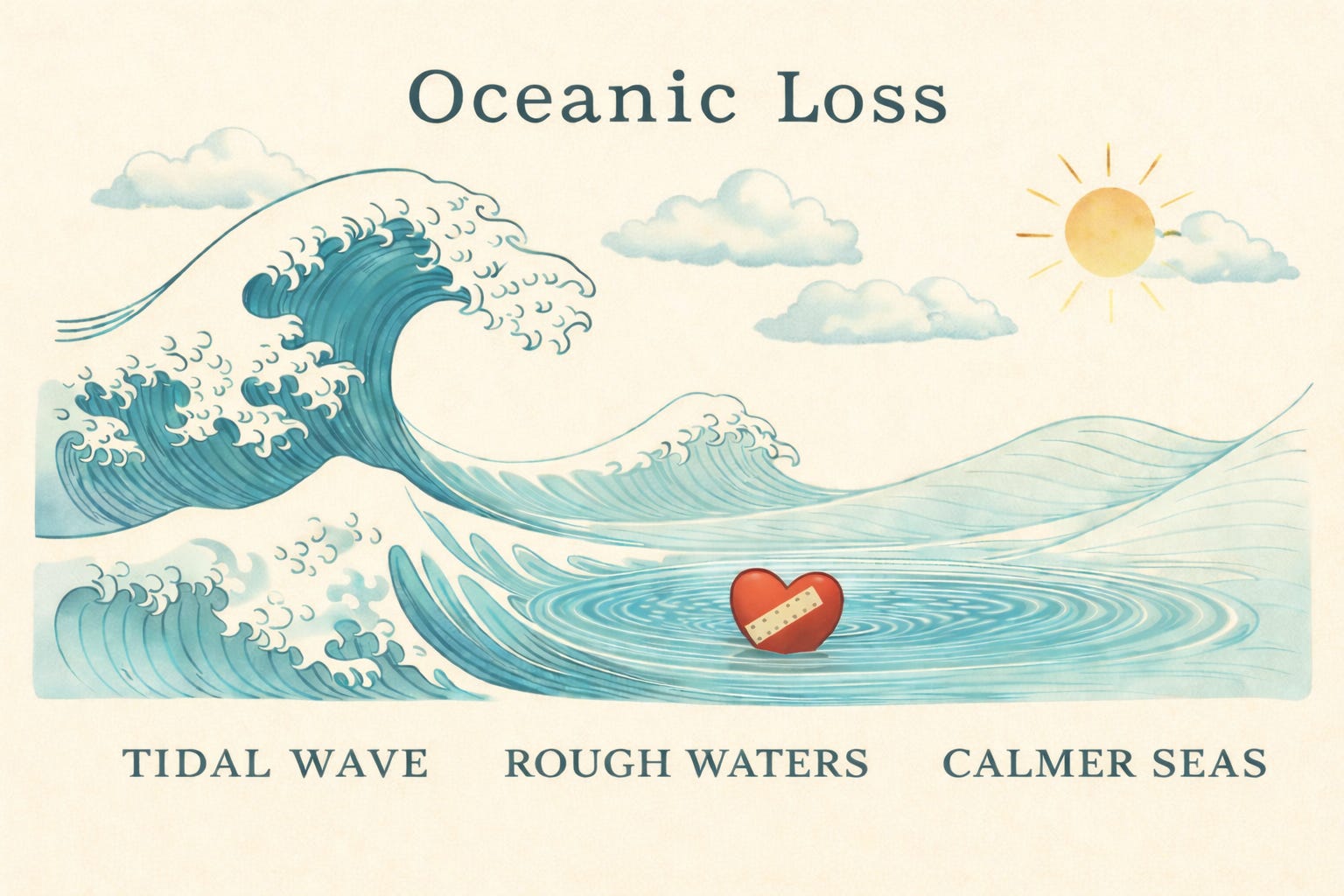
In our culture, we are often taught that grief is a problem to be solved, a mountain to climb and descend, or a process to complete. But when it comes to the complex, Oceanic Loss of family estrangement, pushing toward completion won’t work. Your grief has no expiration date, and trying to force an “end date” only leads to exhaustion.
Grief experts have observed that when someone significant to us dies, we most often process our grief enough that we can place our loss in our back pockets. The relationship stays with us in a quieter way, most of the time. The grief doesn’t end, it lessens.

In estrangement, our loss is even more knotted. We have to tolerate bearing the possibility of hearing from them at any moment—or not hearing from them for years. Our grief can appear at any trigger, then recede. Since we know that this grief will wax and wane, what if, instead of trying to outrun it, we slow down? What if we accept it as our companion?
This past Saturday I heard Lisa Olivera read from her new book, When the Ache Remains, (https://lisaolivera.com/when-the-ache-remains) and this exact theme of integration kept echoing through the room—the idea that healing isn’t about erasing our wounds, but about expanding our lives enough to hold them. She offered a profound shift, writing:
“If you are aching, ask ‘what do you need, grief?’”
Completing her grief was impossible, so she found ways to see her grief as her companion. When you ask how to bear your grief as you live your life, you are choosing to listen to the ache rather than silence it.
Oceanic Loss: A Framework to Help Us Understand Our Grieving
Through my work with families, I have developed the Oceanic Loss framework, which moves through three fluid phases:
The initial shock of the Tidal Wave
The unpredictable swells of Rough Waters
The more resting state of Calmer Seas
Right now, you are navigating Rough Waters. The initial shock has passed, but your sea is still choppy. Your first instinct might be to fight the current or swim away from the breakers.
But walking alongside your pain—asking it what it needs—is actually how you slow down fighting the tide. It is how we learn to float with the ache, allowing the waves to rise and fall without being pulled under. The ocean of your loss doesn’t disappear, but it becomes a body of water you are learning how to navigate.
When in Oceanic Grief: How to Stay Afloat
Slow the Internal Rip Tide: See if you can steer your self-talk to language that offers more acceptance: “Right now, I am aching. This is the rough water I am in today, and it makes sense that I feel this way. I might be able to have other experiences today as well.”
Ask your grief what it needs today: Look for a space for your grief to walk with you rather than consume you.
Locate the Grief Somatically: Grief lives in your body. When the pain flares, try asking: What do I need in my body? Where do I feel the ache? Is my chest tight? Take a slow, deep breath into that tender spot.
Ground Your Physical Self: Place a hand on your heart and your feet on the floor (thank you, Dr. Becky). Let your body know that it is safe to carry this feeling, and that you aren’t going to abandon yourself.
Find Possible Acceptance: Part of what accentuates our pain is the belief in loss’s permanent injury to us. Accepting involves perspective-taking, where we listen to the injury we feel, but also see the possibility of new experiences as we walk through our days.
Release the Need for Ongoing Active Mourning: Parents can feel guilty in moments when they are not missing their child, falling into a magical belief that continuous ache will somehow bring them back. This is not true. Befriending your grief will not push your child further away.
Interrogate the “Victim” Schema: If your family of origin modeled the position of the “victim” as the primary explanation for emotional pain, that stance will visit you here. Acknowledge this view, but ask if you could see your estrangement from another perspective. The purpose is to move you into an active role—one where you have more autonomy in the architecture of your days.
So, Dear Wondering,
You ask how to bear your estrangement: possibly by feeling hurt and alive at the same time. You can carry a heavy heart while noticing the sunlight filtering through the trees.
The goal isn’t to step away from the ache. It is to begin to see that while your loss is your companion, it does not need to fully inhabit you. Your loss can be accepted as part of you, but ultimately not all of you—or who you wish to become.
Kathy
P.S. If you want to practice moving through these stuck places together, I’m presenting a workshop on August 1 with Ann Dyer, the founder of Mountain Yoga. We’ll gather in Oakland and on Zoom for an afternoon of gentle yoga, journaling, and talking through how estrangement lives in the body. You can find more info and reserve your spot here: https://www.m-yoga.org/living-with-estrangement.html
Please reach out to me in the Comments Section or at ksinsheimermft@gmail.com
This is column #45