

To my readers: I am taking time at the beginning of this new year to broaden our topic of estrangement. I will be including columns about friendship (such as this one) as well as adult sibling estrangement.
Dear Kathy,
My best friend isn’t speaking to me, and I don’t know what to do. We have been very close since college, and we are in our 50s. Although we don’t live in the same city now, we have been in constant communication and visited each other frequently throughout this time.
A year ago, she told me she had been diagnosed with breast cancer, and she said she didn’t want me to tell anyone. She was keeping it secret from her friends and colleagues and some of her family members. I was terribly upset and felt I needed support. I told my brother, who knew my friend but was not involved in her life in any way.
In a phone conversation, she intuited that I had told someone! I said, yes I told my brother. She was very angry, and she stopped speaking to me. I am bereft at this loss. I knew she had stopped speaking to her brother and that her mother had cut people off, but I never imagined she could do that to me. She has been such an important part of my life. Is there anything I can do to repair our relationship?
—Heartbroken, lonely and desperate
Dear Heartbroken,
First, your estrangement from your friend, especially when she is ill, is clearly deeply painful. My guess is that you feel the pain differently than she does—you are actively feeling the loss, while your friend has compartmentalized it. Your friend, I’ll call her Liz, is dealing with her cancer by hiding it. She may be trying to hide the cancer not only from others, but from herself as well. “Don’t tell anyone” includes Liz, herself.
Liz likely feels you broke her trust by telling your brother. She couldn’t see that you might need support in tolerating the potential loss of a dear friend. Fear has kicked up for both of you. Liz needed to tell you—and she did. But in her current state, she didn’t have the bandwidth to see that, in order to support her, you would need to tell someone, too.
When two people are in a high-stress situation, the tension often becomes too much for the relationship to hold. Instinctively, one person will reach out to a third person to help stabilize that stress. It’s like a tripod: three legs feel more stable than two when the ground is shaking. You pulled your brother in to help you stand up—a neutral choice, you felt—that shows you were seeking support, not gossiping. But for Liz, who was already feeling exposed by her illness, that third leg felt like an intrusion rather than a support.
Liz grew up in a home where “cut-off” was a family practice. This means she didn’t just see it; she never learned other ways to deal with difficulty. Her family model was simple: you cut people off. While she has been a wonderful friend for years, her cancer diagnosis has made her more mature social skills unavailable. She has fallen back on a primitive, survival-based defense: you do as she says, or you lose contact.
Murray Bowen’s definition of “cut-off” reminds us:
Emotional Cut-off is the process of separating, isolating, or withdrawing from significant others to manage unresolved emotional intensity. It is a reactive “flight” response used to lower anxiety when a person feels they lack the tools to stay in a relationship while remaining their own person.
Liz’s emotional intensity is an understandable reaction to a frightening diagnosis. Dr. Becky Kennedy reminds us: “When we are overwhelmed, we don’t just lose our ability to solve problems; we lose our ability to stay in the room. Disconnection is the ultimate ‘flight’ response.” Liz is currently unable to stay in the room. Your job now is to keep the door unlocked while you find your own balance.
I realize this advice may not alleviate your current pain, which is clearly deeply uncomfortable. Estrangement from a close friend can leave you at a total loss. Friends share our daily lives, help us think about our projects and goals, support us. At first, you may feel left with no internal map to fill in the territory you had shared. It can be a little like a death—only, as with other estrangements, Liz is alive, yet unavailable.
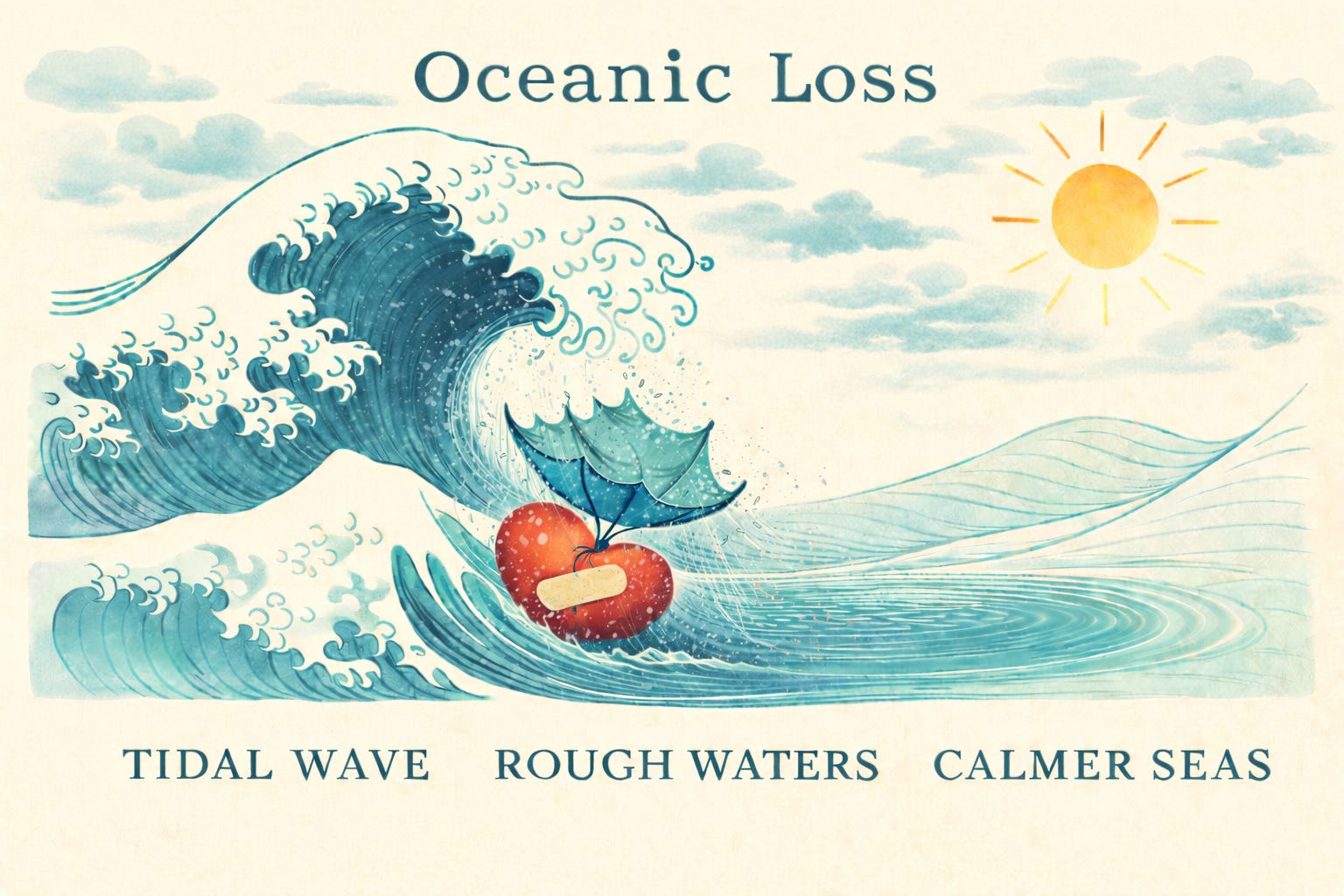
In my Oceanic Loss model, you are currently near the Tidal Wave, entering rough waters and nowhere near calmer seas. You are mourning the premature loss of a friendship due to Liz’s need for secrecy.
It may feel like your friend is punishing you, but my guess is she simply does not have the emotional bandwidth to manage a life that now includes a potentially fatal disease. Harriet Lerner, author of The Dance of Anger, captures this perfectly: “Cutting someone out of your life doesn’t always mean you don’t love them; sometimes it means you don’t have the internal resources to hold the conflict and the love at the same time.”
The Path Forward: Finding a Spot to Stand
Is there a path to repair? Let’s get you grounded first. Beyond the initial shock, you are navigating a thwarted grief—missing your friend’s presence while being denied the chance to care for her during her illness. It is a deeply uncomfortable, heavy mix of love and frustration.
Here are some suggestions for honoring your friend while maintaining your own integrity:
The Deep, Honest, Uncomplicated Apology: Send one clear message that avoids defending why you told your brother and focuses solely on Liz’s pain. “I breached your need for confidentiality and safety. I am deeply sorry.”
Low-Heat Check-ins: Every few weeks, send a “no-response-needed” note. “Thinking of you today. No need to reply—just wanted you to know I’m here.” This keeps the porch light on without demanding she walk through the door.
Hold Her in Your Mind and Heart: While science debates if silent intentions can heal cells, they certainly heal systems. When you hold Liz in your heart with love rather than fear, you potentially lower the strain between you, at least on your side. You are becoming a “safer harbor” for her to return to.
Somatic Practice: When the pain of her absence feels like a “phantom limb,” try this brief Loving-Kindness Meditation:
“May you be safe. May you be at peace. May you be healed.”
You can hold both you and Liz in your heart as you repeat this to yourself.
Self-Care Remains Key
It is vital to stay involved with your own self-care. Being cut off can cause us to doubt ourselves, bringing on bouts of self-recrimination. Punishing yourself for seeking relief will not move anything forward. In all estrangements, chastising yourself for the cut-off only makes you feel worse and does not positively affect the outcome.
So, Dear Heartbroken,
You are in very rough waters. In my drawing for this week, the heart is being crashed by the Tidal Wave, with an inverted umbrella—no protection. Please reinvigorate your self-care practice and elicit compassion toward yourself. You needed to tell someone—the news was simply too big to hold alone. Liz couldn’t tolerate that, and here you are. You are both hurting. You will need to hold this space of distance for now. My hope is that Liz is able to pivot, allowing you both to return to your years-long, deeply held friendship.
Warmly,
Kathy
Please contact me at ksinsheimermft@gmail.com, or write to me in the Comments section.
This is column # 20