

Dear Kathy,
My relationships are falling apart. Three years ago, my husband decided he didn’t want to be married any more. Last year my friend estranged me. This year, my sibling is threatening to do the same. WHAT IS HAPPENING to preserving our closeness? Why don’t we need each other and want to talk and fight it out? What is affecting our values and wanting to be valued?
Lonely, Mad and Sad
______________________
Dear Lonely, Mad and Sad,
You must be scared of what’s coming next!
What you write about is a worrisome cultural phenomenon of people giving up on relationships with each other. Sherry Turkle speaks of our being “deskilled” at human relationships. I do think that is part of what you are experiencing—your family members and friend have resigned from trying to work things out. It is more and more common that people are walking away from each other.
Today, I want to write about a related piece of the puzzle: how changing the rules is leading to a new form of relationship disruption. We’ve changed our guideposts for whether or not we want to be in relationships with our families, with our partners, with our friends. The rules in the drawing below are being dismissed as unhelpful and unhealthy. But perhaps there were ways they did help.
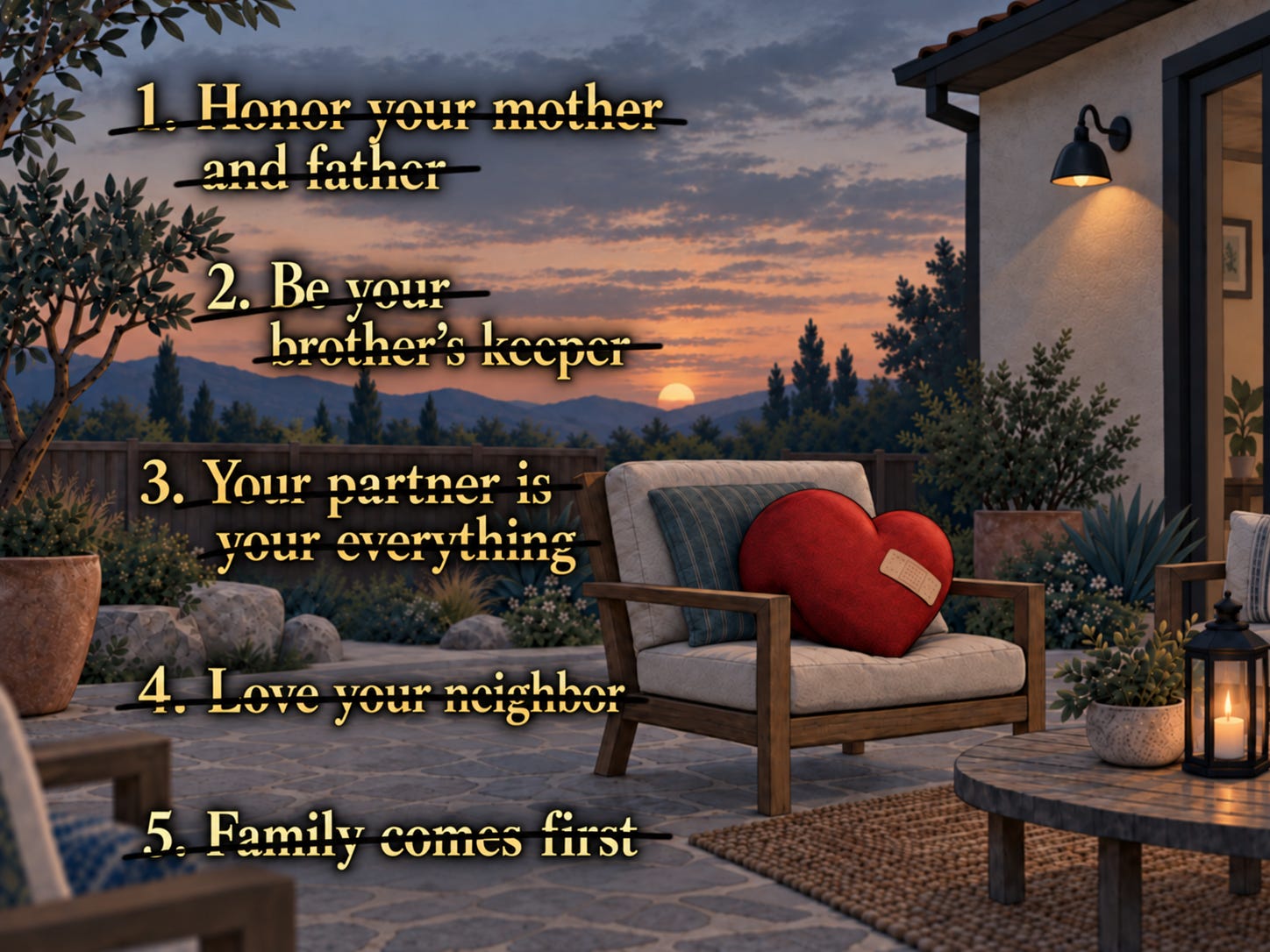
I respect any generation’s right to question the values of the previous generation. (Mine certainly did!) That questioning is supposed to bring about liberating change, and I know I felt my generation’s did just that. But not always.
With relationship norms in flux, and a multitude of choices available—ranging from polyamory and AI partners to blended family iterations—things can get complicated! A friend we will call Sam learned his girlfriend (we’ll call her Sue) wasn’t sure if she really wanted a partner. They had been dating for 3 years and were at a level in their relationship where they vacationed together and were thinking of moving in. Then another alternative popped up: the girlfriend’s previous partner reappeared. It slowly emerged that she might want to try polyamory, or alternatively, to step away from traditional partnering altogether. These are all valid lifestyle options, but I suspect they sometimes act as an escape hatch, bypassing the work that might be done to figure things out in Sam and Sue’s relationship. Were Sam and Sue having trouble continuing because they were struggling to communicate? Did they lack the tools for “healthy heat” (productive fighting)? Did the polyamory option look like a solution when the core problem had been misidentified? Would “re-skilling” in human relationships help?
Let’s go through the list:
Honoring your parents: Does this mean blindly? It may have at one time. Can it mean something else? To remain in contact while respecting your own needs? When estrangement is necessary, there are times it should be exercised. But choosing to work on rough spots in your relationship appears to be a fading art.
Caring for your siblings: Sibling estrangement is also an increasing phenomenon. It can be rough to care for a difficult brother or sister, or to be close when you have differing views, but it might be possible to unpack old rivalries and alignments to find the common ground lying beneath them!
Honoring your partner (and partnership): Being partnered is an extremely complicated undertaking. It takes goodwill, maturity, cooperation, patience, and communication. Even then, there are rough spots! There are many modern configurations in partnering these days. I am not condoning one over another, but I do think the abundance of alternatives can be confusing and lead us to believe that we chose the wrong path rather than recognizing we could learn more about the art of partnering (to borrow part of Priya Parker’s phrase).
Loving your neighbor: I see both love and hate in daily life, and some of us respond to the strains of being human through these extremes. In recent political years, there has been a degrading of respect for difference that fuels increased hostility. I bring this back to our lack of understanding of our own self-hatred. Unresolved self-hatred is difficult to bear, and we often wind up disliking others for things we cannot accept in ourselves. Looking inward with compassion could be deeply helpful here.
Family comes first: Family can be a burden, but it can also be your foundation. Sometimes it’s both. Abandoning family can occasionally be like throwing the baby out with the bathwater. Consider the possibility that you can acknowledge both the strengths and weaknesses in your family system and still choose to remain involved.
What helps?
Identify the problems you or others are trying to solve by changing the rules.
Sort out what is genuinely needed to address them.
Explore targeted solutions such as:
Improving communication
Refining conflict resolution
Reorganizing priorities
Reshuffling and balancing responsibilities
Reclaiming your individuality within your relationship
Chart a path toward making the changes you are looking for. Does it involve shifting habits and practices in your relationships? Very likely! How much it involves altering larger parameters—like going “no contact” or opening your relationship—can be better understood after you have tried to address the underlying dynamics that aren’t working.
____________
So, Dear Lonely, Mad and Sad,
You are right that human relationships are shifting. We are acting as if we no longer need each other as much, and that a shared sense of belonging and relating matters less. This declining desire to connect and sustain is indeed worrisome. Thank you for sharing, and best wishes for renewing your connections with loved ones.
Best,
Kathy
Please reach out to me in the Chat, Comments Section or at ksinsheimermft@gmail.com
This is column #58
I think you missed an opportunity with this person to look inward. There is possibly a reason people are distancing themselves from her and this response only keeps her a victim of external forces. We can only change ourselves anyway, so why not look inward and see if we are creating these problems? Acknowledging our own contribution is the first step to reconnection. We all have to take responsibility for our role (however large or small) in the disconnection or estrangement occurring in our relationships. This is where I believe we must begin when someone is distancing themselves from us.