

Dear Kathy,
My dad asked me if he could send me gifts for Christmas. My mother passed away, and I’ve become estranged from my dad. Our grieving processes clashed, and I eventually separated myself from him in order to grieve on my own.
Part of me wants to say “yes” in hopes of easing the strain and maybe opening a door. But part of me wants to say “no” because he hasn’t really tried to understand our problems.
If I say “yes,” will he feel he can buy me presents and act like everything is better? Or would it help our difficulties if we exchange presents as a symbol of trying to reconnect? Part of me misses our old family traditions and being together. Part of me doesn’t—I’m too disappointed and hurt. Could you help me sort out my feelings?
Signed,
Confused and Torn at the Holidays
Dear Confused and Torn,
You raise a very frequent topic this holiday season: In estrangement, it’s tough to know what to do about gifts when contact is limited and there are many unresolved feelings.
Gift-giving reminds us of earlier times when the holiday structure seemed to hold us together. We miss the traditions, yet being together doesn’t feel safe because the relationship is fraught. You still feel connected, but the connection feels fractured, with deep structural damage.
The Symbolism of the Gift
Before we decide on an action, it helps to understand what a gift symbolizes—both for you and for your father.
Note: This column about gifts applies to many estranged families, not only families who have lost a parent.
Ideally, gifts are a gesture of love and a demonstration of how the giver sees the receiver. We all crave that feeling of being understood. In the film Me Before You (2016), the character Lou receives a pair of bumblebee tights she loved as a child. She cries, “It is the best thing you could have given me.” It wasn’t about the tights; it was about being seen and remembered.
Parents who want to send gifts to their estranged children are often trying to reestablish that feeling. They want to reach back to you through a familiar means. When you were young, the excitement of the tree or the Menorah was a shared pleasure. By asking about sending a gift now, your father may be hoping to rekindle those earlier times of closeness.
For the parent, the “ask” isn’t just about the object. It is about the ritual: shopping, wrapping, shipping, and waiting to hear if the gift landed. In all these steps, the parent feels connected to you. They are likely trying to say something they cannot express with words.
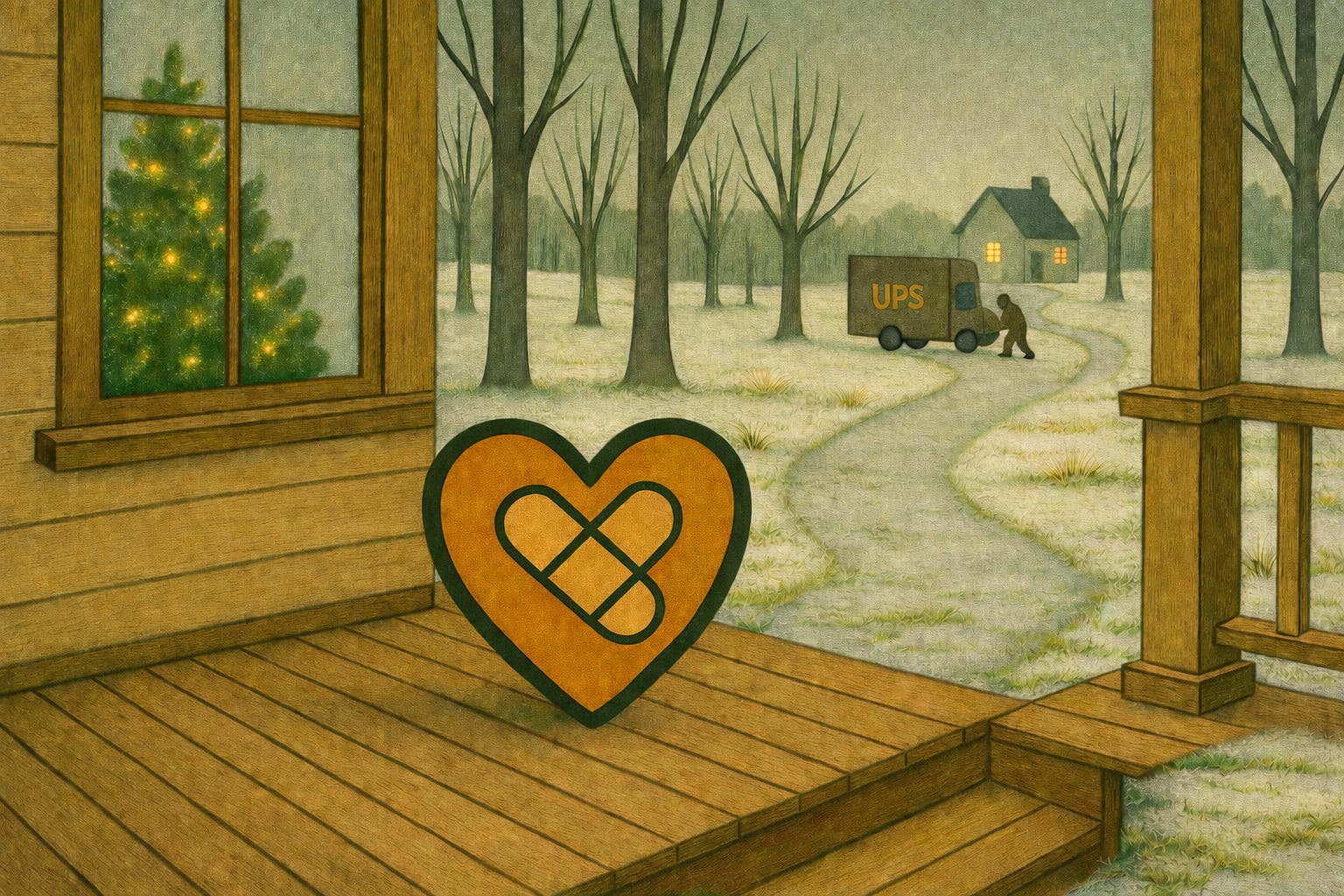
Unpacking the Conflict
For you, the gift carries a heavy weight. Let’s unpack your complicated feelings.
You are afraid that by saying “yes,” you give your father the opportunity to sweep the real issues under the rug—buying his way out of the hard work of repair. Conversely, you are afraid that by saying “no,” you might miss an opportunity to melt some of the ice between you.
In the illustration above, a bandaged heart sits on the porch while a delivery truck looms in the distance. We can’t tell if the heart is wishing the driver has packages for it, or hoping the driver drives right past. Or both!
This is the ambivalence of estrangement. We may want to be close again, but we are afraid it will feel like sandpaper on our skin. We ask: How do I find a way back together while still preserving my need to live my life as I need to?
The Double Layer of Grief
Your letter reveals two layers of grief. You lost your mother—a profound tragedy. Then, because the grieving dynamic with your father was so difficult, you had to distance yourself from him as well. Effectively, you have lost both of your parents.
This distance from your father has served you well for a time, allowing you to grieve your mother without interference. But now, you feel a shift.
In a conversation with grief expert Dr. David Kessler, psychologist Dr. Becky Kennedy noted, “We can’t change the hard, but we can change the alone.” Your openness to receiving a gift may indicate that you are ready to change the “alone” to help you move forward.
Dr. Kessler added, “What we run from pursues us; what we face transforms us.” Are you possibly ready to face your father and have a conversation about your frustration with his past actions?
If we have cut someone off to protect ourselves, have we also cut off a part of ourselves that we wind up missing? Facing the decision about the gift isn’t just about your dad; it’s about facing your own grief and your future.
Strategies for a Decision
So, what should you do? Before you reply to his text or email, I suggest using these journaling exercises to clarify where you stand right now:
Line up the conflicts: List the specific issues standing between you and your dad. Look at them clearly on paper or a screen.
Evaluate your strategies: Write about how your current strategies (silence, distance, arguing) are working. Are they making you understood? Are they protecting you?
Identify your desires: Write about the part of you that wants to “ease the strain” as well as the part that sees distance as the safest choice. What do each of those parts of you need?
Draft your responses: Write three different drafts of a response to him:
Draft 1: The “Yes.”
Draft 2: The “No.”
Draft 3: The “Conditional Yes” (e.g., “Here is what I need you to know and/or do before I accept this.”)
Look at the drafts to determine if they have helped you find your answer. My hope is that seeing it all lined out will help you find a way forward this holiday season with more clarity and continued self-preservation.
Making the Implicit Explicit
If you are ready to look at a path for moving beyond your current distance, my advice is to ask for that “new path” as your real gift.
Make what is implicit explicit. You can tell your dad, “I appreciate the gesture, but the gift I really need this year is for us to address [Topic X].” Perhaps the exchange is his asking to give you gifts, and you asking him to address your requests for conversation, growth, and new understanding.
Consider this:
Accepting the Gift ≠ Accepting the Behavior
Opening the Present + Unpacking the Past = Possibility in the Future
My wish for you is closeness with trusted loved ones this holiday season. And, if you begin work on reconnecting, I hope you find enough safe space in your feelings that you wind up feeling closer than when you began.
Best,
Kathy
Please write to me in the Comments section or email me: ksinsheimermft@gmail.com
This is column # 16
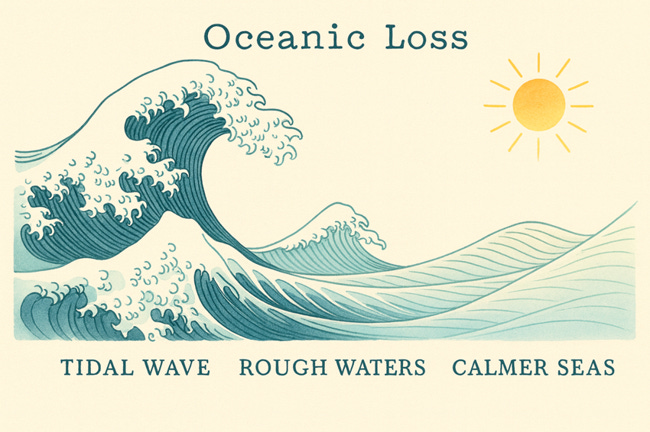
The idea that the real “gift” might be asking for a new path rather than accepting an old ritual is powerful. This does a good job holding grief, ambivalence, and self-protection in the same frame without forcing a tidy answer.