

Looking Around the Room
Last week I began offering a weekly brief somatic activity to alleviate some of the emotional strain of estrangement. I’m hoping the activity helps you experience some relief as you make your way through your separation from your loved one.
This week, the brief activity involves Orienting to help you center and slow down. I will embed a video in this column to talk you through the activity.
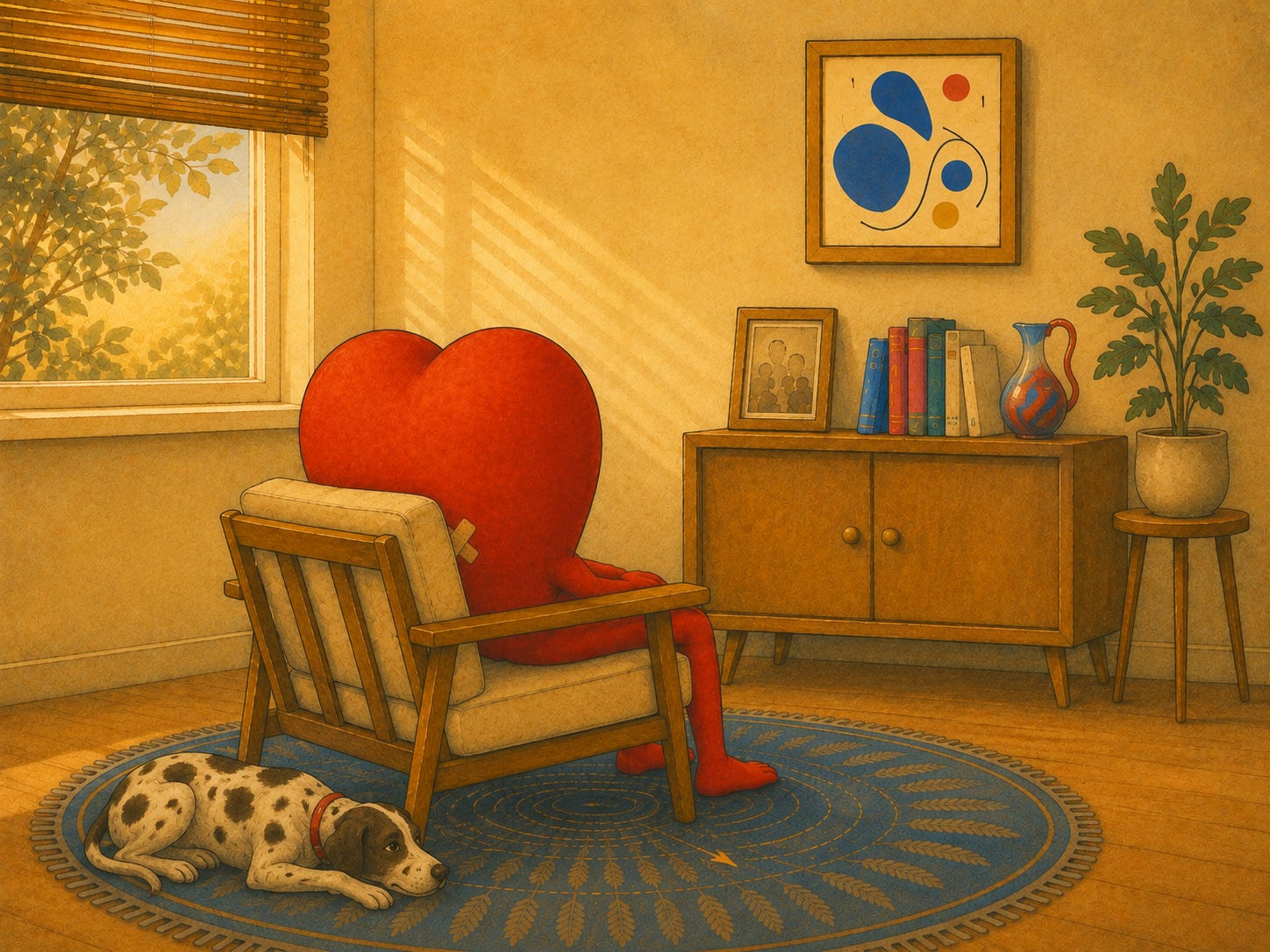
When emotional distress spikes, our bodies instinctively prepare for a physical threat. Without our realizing it, our vision narrows into a tight spotlight, our neck muscles lock up, and our nervous system gets stuck in a loop of scanning for danger.
If looking inward feels like too much right now, we can look outward instead.
Orienting is a natural reflex our bodies use to confirm safety in our surroundings. It requires no vigorous movement, no breath work, and no digging into painful emotions.
The Practice:
Make sure you are in a space where you feel safe.
Wherever you are sitting, allow your head to turn slowly from side to side.
Let your eyes wander freely around the room without searching for anything specific.
Let your gaze rest on two or three neutral, ordinary objects—a book on a shelf, a patch of light on the floor, a houseplant, or a picture on the wall.
Name each object silently to yourself, noticing one detail like its color or shape, before slowly moving on.
Why It Works: Your brain’s alarm center will keep signaling danger until it receives real-time evidence to the contrary. When you gently turn your neck and let your eyes take in everyday, peaceful objects, you break the body’s freeze response. You are providing visual proof to your nervous system that the space around you is secure right now.
Please let me know whether of not this activity was helpful to you, and how so.
Best,
Kathy
You can contact me through the Chat, the Comments, or email me: ksinsheimermft@gmail.com