

Dear Kathy,
After several years of thinking I HAVE to do something about my estrangement, and trying all ways to reach my child, I have taken a break. At first, I was really sad. I am terrible at “giving up” and this was no exception. Then, after several weeks, I began to notice that I was less preoccupied with my estranged child.
I have been making myself go to exercise class—dragging myself through it, really. Now, I at least felt like I had some energy to participate. Don’t get me wrong, lots of people in the class are more energized than I am, but I have some “juice” to bring to the movements.
Is it OK that I feel a little better? What could happen if I let this go on for a little while?
— Finding Some of My Juice
Dear Finding Some of My Juice,
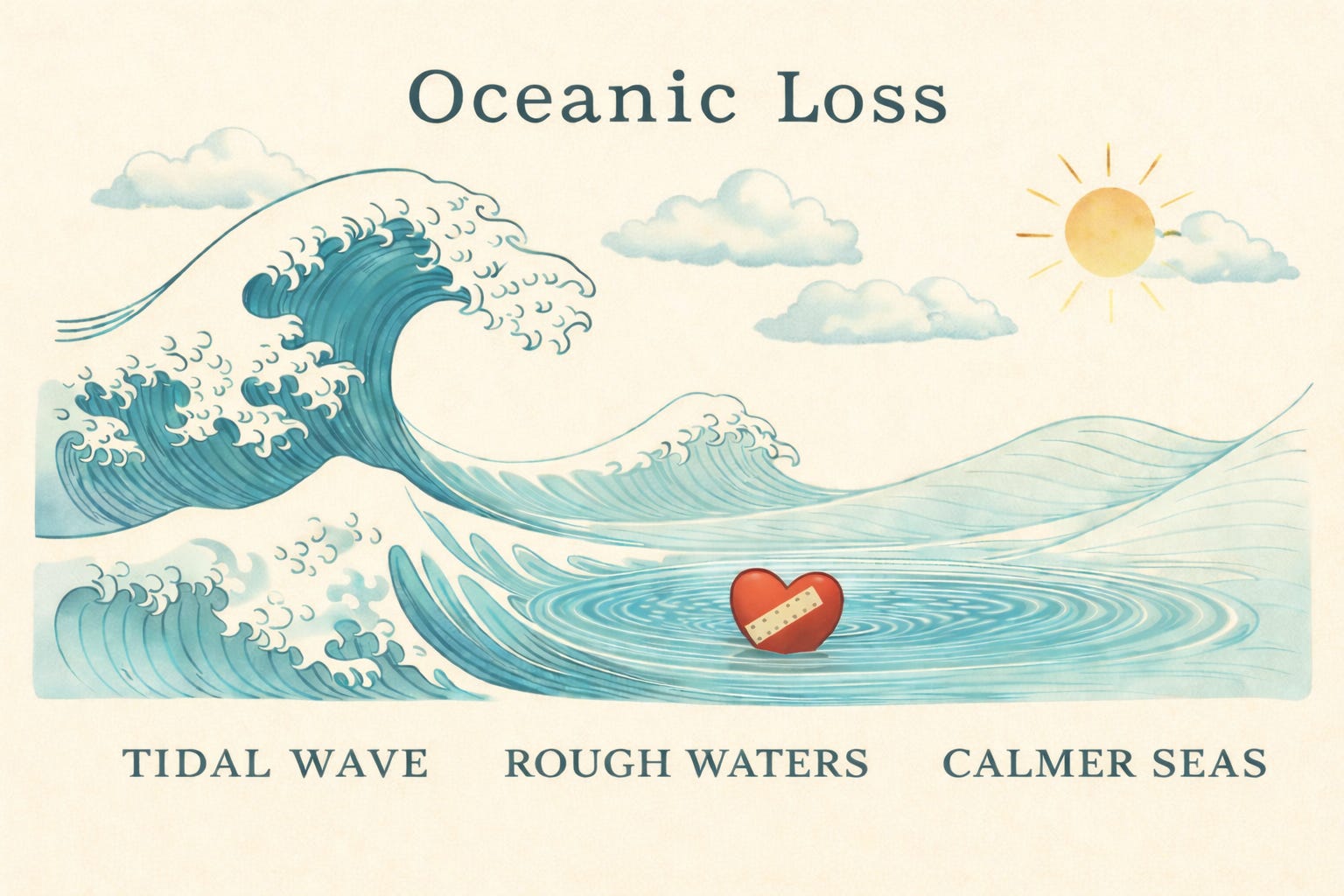
We are in the third and final column of our series revisiting the Oceanic Loss model in honor of Dear Estranged’s first birthday. I couldn’t have chosen a better letter to conclude with, because you are describing what it feels like to swim in Calmer Seas.

You feel a little better. What you are experiencing is not defeat, nor is it giving up.
In my model of Oceanic Loss, grief does not progress in a linear fashion toward “closure.” Instead, grief ebbs and flows through three distinct waters: the initial shock of the Tidal Wave, the relentless churning of Rough Waters, and quieter periods of Calmer Seas.
For several years, you have been battling the waves. When an attachment bond is severed, our powerful pull is to repair it—to throw every ounce of emotional muscle into closing the divide. But living in chronic pursuit and agitation keeps your nervous system perpetually braced for impact. Frantic paddling is exhausting, and it doesn’t necessarily get you to the waters where you hope to swim.
That “juice” you are beginning to feel in your exercise class is energy resurfacing in your own body. You have recaptured some of yourself from your devoted pursuit of your loved one. You are feeling that energy in a part of your life where you can actually sense your own vitality and presence.
In Calmer Seas, your loss doesn’t vanish. As you see in the drawing of this phase, the heart floating in those gentler waves still wears a bandage. The difference is that the cresting swells have, for however long, moved to the perimeter. The water has calmed enough for you to catch your breath, look around, and realize: I am still here.
Calmer Seas Are a Phase, Not a Final Destination
It is important to understand that floating in Calmer Seas is not a marker of perpetual smooth sailing. Just like the other waters in this model, it is a phase you inhabit, not a permanent finish line. Shifts in life circumstances can abruptly alter the tide.
Recently I heard from an estranged mother who had been experiencing a period of relative calm, but was suddenly thrown back into acute grief and depression. She received an unexpected letter from her son announcing a second pregnancy—paired with a painful edict not to reach out. This mother had once enjoyed contact with her first grandchild, but that door had since closed. Now, facing an expanding family from which she was explicitly excluded, the loss hit with fresh, devastating force. In an instant, she transitioned from Calmer Seas right back into a towering Tidal Wave.
If this happens to you down the road, it does not mean you have failed, or that the peace you felt before wasn’t real. It means a new emotional earthquake has struck, sending fresh shockwaves across the waters. You are thrown off course by fresh heartbreak.
A Note on Losses That Resist Calm Waters
Before I say more about when waters might settle, I also want to acknowledge those who carry grief that resists calm, period.
Grandparents tell me that being cut off from grandchildren carries an especially acute, complicated, ongoing heartbreak. When an adult child cuts contact, there is at least an adult dynamic to grapple with. But being severed from grandchildren feels deeply powerless—you are left grieving young children who have no say in the separation, watching milestones pass from afar. For many grandparents, “taking a break” from grieving feels unbearable, as if stepping back is abandoning their grandchild.
I will take up this subject in future columns, but I want to be sure to acknowledge what grandparents have told me and recognize that Calmer Seas can feel unavailable at this level of heartache.
Living Alongside Your Grief
The Calmer Seas phase is not about forgetting your child. It is about finding space to live alongside your grief—not fully inhabit it. You can hold sorrow for the rift in one hand, and still, at times, experience your own vitality in the other.
You become a steadier harbor for yourself: in the thick of the storm, outreach often carries the frantic energy of our own panic. If a path toward contact ever opens down the road, your estranged loved one will find you more rooted in your own life.
“Healing isn’t about getting rid of the ache. It’s about expanding your capacity to hold the ache while still showing up for the life you have.”
— Lisa Olivera
Practical Ways to Possibly Access Calmer Seas
Begin a practice of centering yourself: This does require you to try to set down your active grief. If that feels unbearable right now, wait until you feel ready. I have started to make a once-a-week offering of a centering exercise in this Substack column, published early in the week. You could try that, ask friends for ideas, or search for exercises that help settle your nervous system. Be sure the exercises are at the right level for you—focused breathing, for example, can feel too intense or emotional for some in acute loss.
Return to parts of you that you may have set aside when you became a parent: Did you have hobbies, sports, or volunteer work that you used to enjoy? Gardening, knitting, pickleball, literacy support… what of those could you return to? You can begin to re-establish your importance to yourself and others by joining activities and slowing yourself down as a gift to yourself.
Make plans with people who enjoy you: Seek out those who genuinely want to spend time together. Take walks, play cards, do a puzzle. Enjoy each other’s company.
Check in with yourself about your reaction to doing more for yourself: Notice any negative voices criticizing you for setting down your active search for contact with your loved one. Tell them: “I know you; I hear you; but that doesn’t need my attention right now.” The voices can wait. You have tried everything, and you need a break. Self-care is key to making it through tough times, and it is vital in navigating estrangement.
Dear Finding Some of My Juice,
Thank you for sharing your calmer feelings. It isn’t simple to accept the lightening of your loss—you wonder if you should remain intensely focused on your estranged loved one.
I hope you will find genuine relief in your respite, and I am so pleased that you get this well-deserved break.
Warmly,
Kathy
Please send your questions about estrangement to ksinsheimermft@gmail.com or Comment or Chat here on Substack
This is column # 54
Wow, this is so spot on to our situation. When our DIL was expecting their 2nd child, we sent a text asking how things were progressing for delivery. We got a reply that they would be inducing the following day and then we told very directly, that we should not expect to visit anytime soon and they would let us know when they are ready, we were also told if we sent a text to not expect a response.... we are still waiting on nearly 2 years to be able to meet our 2nd grandchild for the first time. It is encouraging to me that my husband and I are not alone in this big sea and we are all scrambling to carry on with our own lives.
Thank you for yet another helpful and insightful article. I feel I am in the calmer seas right now but I know that at some point the waves may return. I am more ready for that now. I must say I find the letter from that estranged son to his mother announcing a second pregnancy and then directing her to stay no contact is unbelievably cruel. There are no other words for that – he is sending her a cruel message that was unnecessary and served no purpose but to stab her in the back. Reprehensible, in my opinion. He needs to look in the mirror and grow up.