

This column is about boundaries—often a controversial word in the world of estrangement. I wrote it in response to a communication with an estranged adult son. Too often, “cutoff” is seen as the only boundary available: a wall built as high and long as the Great Wall of China. In this column, I am not talking about cutoff. I am talking about the guardrails that help you return to a relationship that has veered off course. If you can find the right, healthy guardrails, you may be able to return to a more active relationship with an estranged loved one.
Dear Kathy,
I am turning 50 this year. My father and I have been off and on estranged throughout my adulthood. I am one of four children and two of us are estranged from our dad. Whenever I reconnect with Dad, it goes well for a little while, but then he begins to ask me to do things for him that cross the line—not good for me, but also not good, ultimately, for him. I actually think he may be one of those parents you read about who struggles with immaturity. He doesn’t take “no” for an answer.
I don’t like being out of contact with my dad and I don’t like the example for my kids. He’s getting old and becoming frail. I love him and I’d like to reconnect, but I’m sure we will be in the same impossible spot before very long. Do you have any suggestions?
—Missing Him but Extremely Cautious
_____________________________________
Dear Missing Him,
I’m sorry to hear how rough it’s been with your dad. You are missing him, but it doesn’t seem safe—or perhaps wise—to reconnect without a new plan. When you tell me he won’t take “no” for an answer, I wonder if this is where some good boundaries might help.
Boundaries 101: The Open Fence
In too many families, boundaries have been used as a weapon—a way to say, “If you do this behavior, I can’t be in a relationship with you.” It’s no wonder so many are afraid of them. In the current “therapy-speak” culture, boundaries are often presented as ultimatums meant to change someone else’s behavior. But a true boundary isn’t a threat; it is a way to protect your peace so you don’t feel you have to leave.
I want to suggest that a healthy boundary isn’t typically a wall to shut someone out; it is the very thing that makes it safe to let them in. As Nedra Glover Tawwab reminds us:
“Boundaries are the distance at which I can love you and me simultaneously.”
The most effective boundaries are like fences that let air and light through but keep out what they are meant to keep out. Think of a Two-Rail Post and Rail fence. It marks where your property stops and his starts. Some things travel back and forth—like music, light, or conversation—but much is contained by the rails.
Boundaries are a way of talking about being separate. This process of “differentiation” is a lifelong task. As the pioneering family therapist Murray Bowen famously put it, the goal is:
“To be in emotional contact with others yet still be autonomous in one’s own emotional functioning.”
We need this sense of autonomy to grow and mature. When that developmental separation is discouraged, tested, or fails, it often leads to estrangement, because the adult child simply cannot find another way to protect his own space.

“Two Things are True”
When you set a boundary, it’s important to be aware of what is under your control and what isn’t. To navigate this, I suggest applying Dr. Becky Kennedy’s “Two Things are True” concept. While she often uses this framework for parents and young children, the principle holds a powerful truth for adult relationships, too.
In your case, it looks like this: You can be a good son who is firm with your boundaries, and your father can be a good parent who is upset by those boundaries. You can be a deeply loving, compassionate son, AND you can firmly say “no” to your parent’s unrealistic requests. One does not cancel out the other.
The Discomfort of the “Upside Down”
There is something so upside-down about this role reversal that it can feel deeply uncomfortable. Traditionally, the way you were taught to respect your father was to do as he expected. He set the limits, and you did your best to follow them. To protect your relationship now, you have to turn that dynamic on its head.
You would step out of the traditional role of the “good son” and perform a role that feels more like a parent—respectfully setting a limit and asking your parent to follow it. This reversal, while necessary, is often painful. You may find yourself grieving the father you wish he could be as you step into the role you wish he would fulfill: the one who sets the healthy boundaries.
Be Prepared (Part 1): Anticipating Your Father’s Reaction
Untangling your needs from the struggle with your parent is the first step. Part of that is knowing the “weather” you are walking into. Be prepared for your dad to possibly do one or more of the following:
Be really glad to hear from you.
Not understand what you are trying to tell him about his behavior.
Try to convince you that what you are thinking will happen actually won’t happen.
Become (likely temporarily) upset or angry that you want to set a limit.
At first not push the limit—but eventually do so.
After a period of time, accept the limit and push it less frequently.
Be Prepared (Part 2): Anticipating Your Own Experience
This is a heavy lift, and your own internal state will fluctuate. Be prepared to experience some of the following:
Relief that you are not cut off from your dad and are modeling what you want for your children.
Worry about how this will play out.
Testing: You will be tested by your dad being upset or pushing on the limit.
Upset: You may be upset by your dad’s reaction if he denies the behavior or gets angry.
Need for Support: Inform and consult your circle—your partner, friends, and your siblings. Since your siblings have different relationships with your father, their reactions may vary. Ask them to respect your “fence” even if they handle him differently.
Settling In: Eventually, you can settle into this new role of being able to tell your father “no” while remaining in loving connection with him.
Navigating the Aftermath: The Emotional Weight of the Open Fence
As you begin this work, you aren’t just managing a person; you are managing a history.
The Broken Record: Because he has a history of not hearing you, you might wind up feeling like a broken record. You aren’t being stubborn; you are being constant. If you stay steady, saying “no” will hopefully become a habit—a routine piece of fence maintenance rather than a family crisis. This will become easier over time.
The Challenge of Emotional Fallout: This change will stir the waters and bring up old memories. How has your father’s difficulty with limits affected you over time? Older emotional reactions may get stirred up. While initially uncomfortable, this could lead you to greater self-understanding over time.
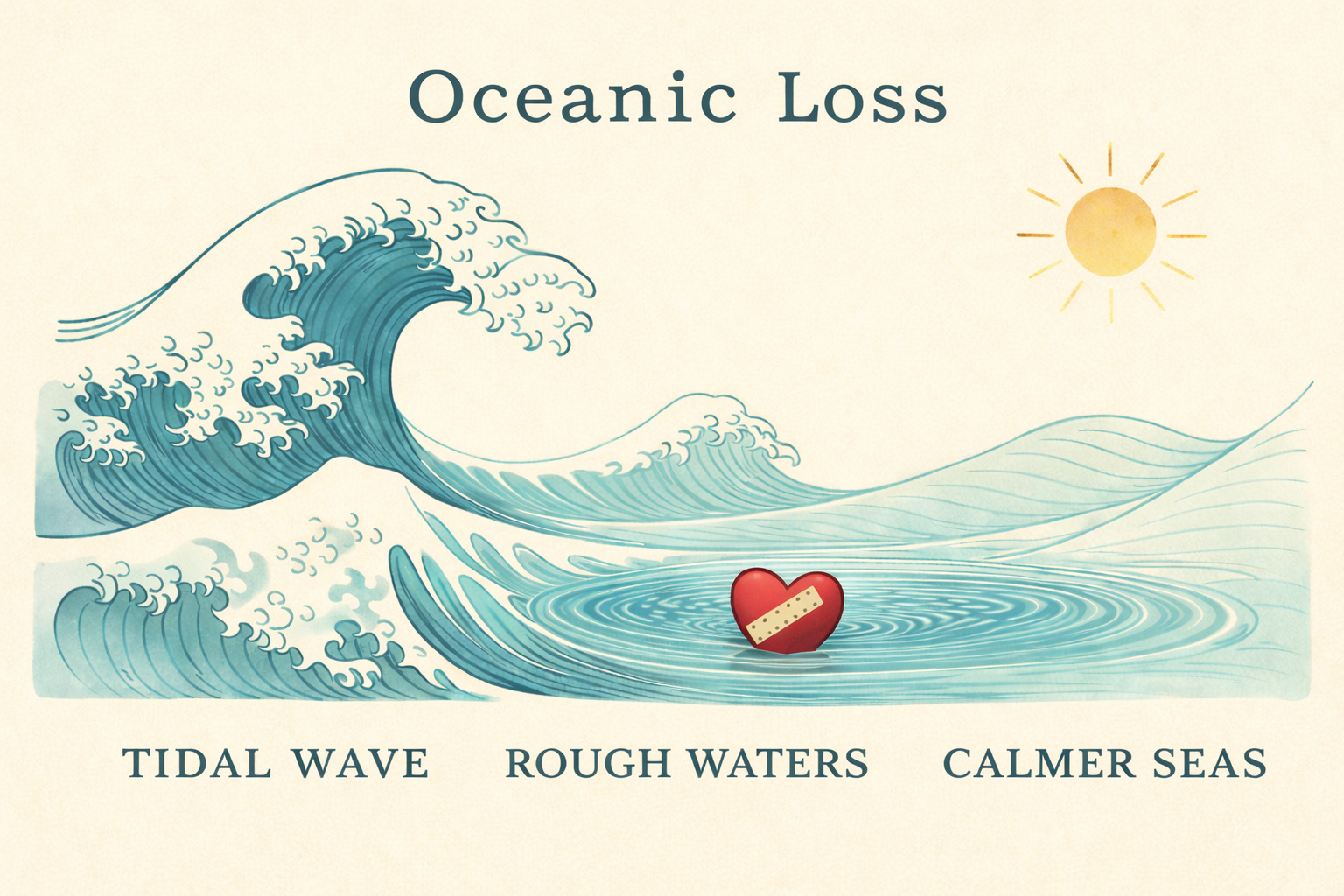
A Temporary Return to “Rough Waters”: You may find yourself grieving your wish that your father could be the one to provide the structure. By taking on the role of the limit-setter, you are accepting that he cannot. This realization often places you in Rough Waters in my model of Oceanic Loss. (Model posted below). As your boundary begins to work—and I hope it does—it may well lead to a good, changed, more functional connection with your father. This would take you out of Rough Waters and return you to Calmer Seas.
So, Dear Missing Him,
Building the emotional muscles to say “no,” bearing the sadness that your dad may not change, and navigating the Rough Waters of Oceanic Loss is a lot.
However, you love and miss your dad. And you want to set a healthy example for your children. If you are able to build a secure, open fence around you—one that lets in light and air—you may be able to stay connected but separate enough to give and receive the love you feel with your father. You will be modeling for your own children what it looks like to be in a loving, respectful relationship with good boundaries.
I am wishing you the best in this deep and rewarding challenge.
Kathy Sinsheimer, MFT
Please contact me through the Comments section, or email me at ksinsheimermft@gmail.com
This is column # 26
Thank you so much for this question. It’s the exact bridge we need to move from the theory of healthy boundaries to the daily work of maintaining them. You’re right—knowing 'what to say' in the heat of the moment is where the real work happens. I am preparing a short post to answer your question. I will publish it soon!
What are some.examples of healthy boundaries?