

Dear Kathy,
When I talk with my family members, I am stunned by how differently they see us. Not just as individuals and not just as a group, but even our history! Why does this happen? And, more to the point, how do we work things out when we don’t even have the same starting place in our perceptions?
Wishing for new glasses so I could see my family better
Dear Wishing for New Glasses,
I think you are at a great starting point—you have noticed a key to why we have differences—it’s about our perception. And our perceptions come from each of our unique views of each other and our experiences together. Preparing to respond to you, I remembered the parable of the 5 blind men and the elephant. (Which we could now re-name the 5 blindfolded humans and the elephant. Or the 5 blindfolded family members.)
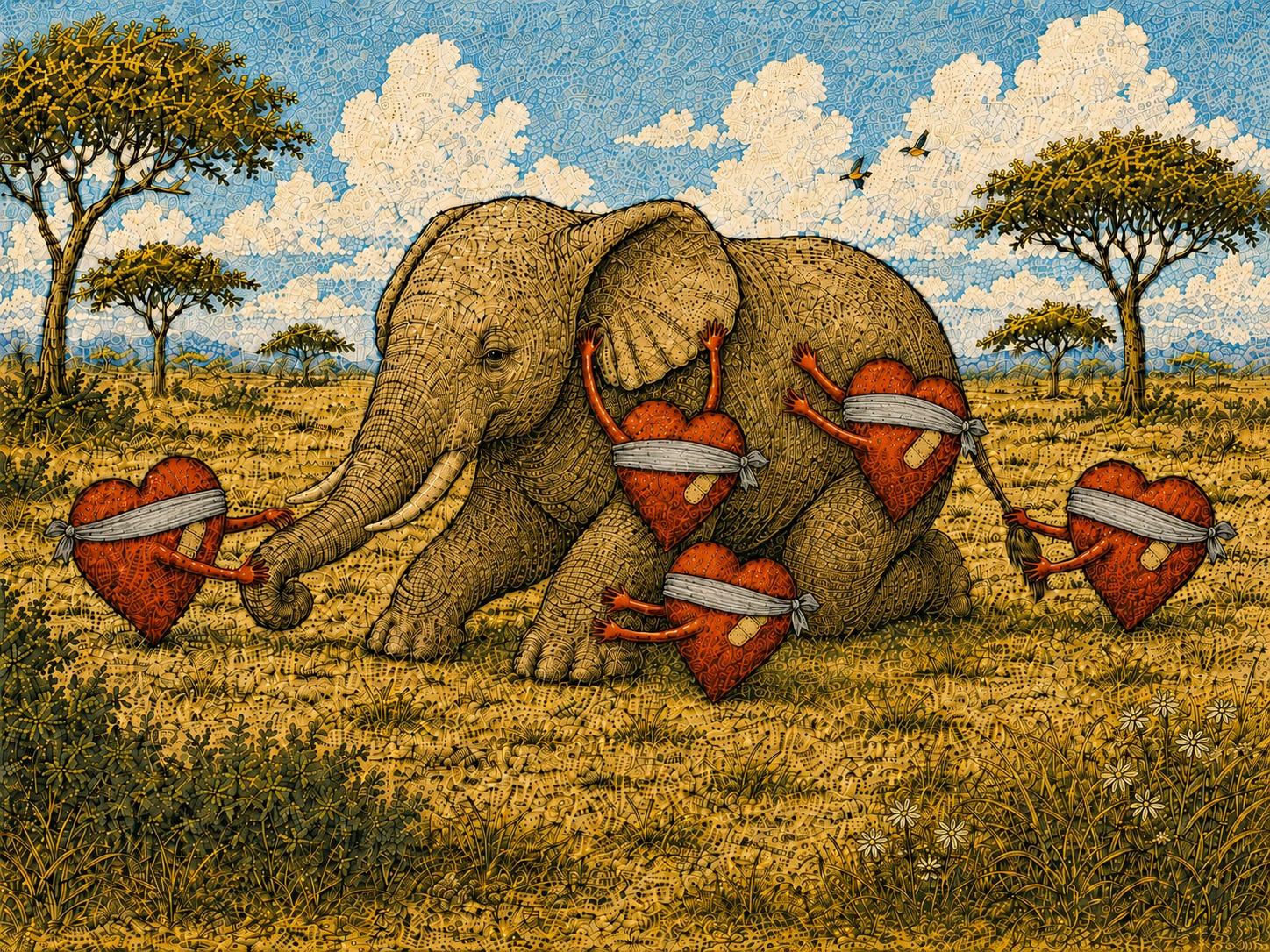
To review for those who don’t know the parable: one human is holding the leg and thinks the elephant is like a tree. Another is feeling the elephant’s side and thinks an elephant is like a wall, etc. I used this story for the theme of my drawing this week, which features five blindfolded hearts trying to map out a giant elephant. Looking at the drawing, you will be able to tell the rest of the story yourself!
When we look at each other and our interactions, we each have unique take-aways. One family thinks that the older child is arrogant and selfish. That same child tells me he needs to save himself from a family dynamic of low self-esteem and defeatism. A friend tells me her estranged Bestie was too self-involved. The Bestie responds that her estranged friend wouldn’t stand up for what she wanted, and then blamed the Bestie when she didn’t get it.
What if each of them is telling a part of the story that could add up to a whole, but they can’t hear each other, so remain stuck in their unique but incomplete perceptions of each other and their relationships? This can often lead to family estrangement—or a painful rupture between close friends—if someone despairs of ever being heard, validated, or understood. If we get stuck in believing a particular narrative, another with a different viewpoint can feel silenced, criticized, or trapped. And if their attempts to explain themselves are not understood due to the overarching family narrative, they may feel the need to distance themselves entirely.
What do I mean by “Overarching Family Narrative”?
Families typically have stories they tell about who they are, what they are about, and how they operate. “We are a family with a fair amount of depression.” “We are a family that has fun but we sometimes spoil it.” “We are a family that works hard and isn’t so good at playing.” “We are a family that’s close but we can’t always tell each other what is on our minds.”
You don’t say what your family narrative is, but I am guessing that part of it is “We are a family that doesn’t agree about our history.” Saying that out loud may actually be the first step for you in making progress. But why does a disagreement over family history feel so terrifying that it can drive us to detach, causing family estrangement?
Are We Fighting For Survival?
Why do we cling to our perceptions so fiercely that we are willing to fracture our families to defend them? It is at least in part because our ancient neurobiology treats a shared reality as a matter of literal survival.
In our evolutionary past, if the tribe couldn’t form a shared representation of reality—if we couldn’t agree on where the danger lay or locate the enemy—the group’s defense fractured, and the tribe suffered. This same need to identify danger is sometimes present in modern times. However, in our daily family life, this need may cause conflict when understanding and compassion for difference would be more effective.
When a family member disputes your reality, your ancient survival brain registers it as a catastrophic fracture in tribal safety. The visceral distress you feel—the tightening chest, the fight-or-flight response—is a primitive evolutionary alarm.
If we cannot resolve the disagreement, our minds default to a primitive, binary way of thinking to restore order.
The great anthropologist Claude Lévi-Strauss noted that human cultures naturally organize a chaotic world into strict, opposing pairs: Us versus Them, Inside versus Outside, Safe versus Dangerous.
When we cannot achieve a shared reality, our collective system splits. To protect our internal reality, we map the binary onto ourselves and our loved ones: I am the truth-teller, and you are the enemy.
When being a part of the family tribe pressures you to abandon your own reality, detaching can feel like an essential act of self-preservation. This is an underlying engine of family estrangement. We pull away because the emotional vertigo of living with someone who denies our truth feels like an undeniable threat to our safety.
Tolerating Differing Realities
Moving forward asks for a profound perspective shift—it requires making space for a reality that looks completely different from your own without triggering the tribal alarm. Here is how we can begin to heal these rifts:
Start with the assumption that you have an incomplete story. To use the parable of the hearts, if you are holding the leg and think the elephant is like a tree, your experience is real—but it isn’t the whole elephant. Accepting that a family member is holding the tail and experiencing something entirely different allows two truths to exist at the same time.
Notice the somatic shift. When a family member presents a reality that jars you, pause and check in with your body. Notice the tension in your shoulders or the urge to interrupt. Grounding your nervous system first is essential; we cannot take in an emotional difference if our bodies are in fight-or-flight mode.
Drop the need to convert. The goal of these difficult family conversations isn’t to get the other person to say, “You are right, my memory was wrong.” As the renowned relationship expert Esther Perel wisely points out, “It’s not hard to be right, but then you are right and alone.” When we demand that our loved ones surrender their perception to ours, we choose compliance over connection. Connection comes from seeing if it’s possible to understand what it feels like to be them in our family.
Expect the emotional vertigo. Expect to feel thrown off-kilter by their perception of “what happened.” It is painful to take in a narrative that feels alien to you. Give yourself permission to feel discomfort without immediately rushing to fix, correct, or cast them out as the “enemy.”
Bring compassion to the blindspots. Approach the conversation with patience for both of you. We are all blindfolded hearts doing our best to map out the giant, complicated elephant of our shared life.
___________________________________
So, Dear Wishing for New Glasses,
You are not alone in your wish to see and understand your loved ones more clearly. Navigating estrangement and learning to tolerate our differences is a life-long process. You will get better at it, and still not “get it” all of the time. Bring your patience and compassion along to help increase the vista for the new vision you are seeking.
Best,
Kathy
P.S. If you want to practice moving through these stuck places together, I’m presenting a workshop on August 1 with Ann Dyer, the founder of Mountain Yoga. We’ll gather in Oakland and on Zoom for an afternoon of gentle yoga, journaling, and talking through how estrangement lives in the body. You can find more info and reserve your spot here: https://www.m-yoga.org/living-with-estrangement.html
Please reach out to me in the Comments Section or at ksinsheimermft@gmail.com
This is column #46

Thank you for your insight. Explains lot. Very grateful.